

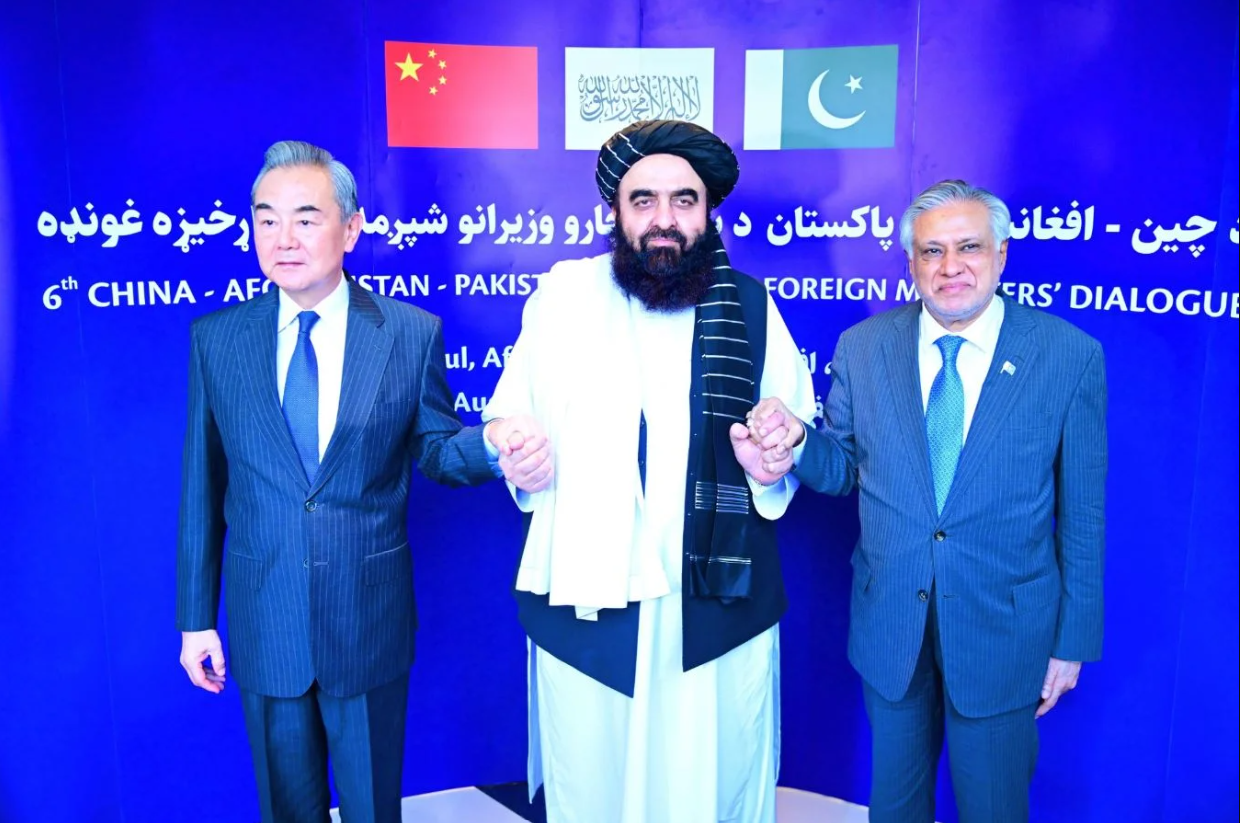

Deputy Prime Minister and Foreign Minister Ishaq Dar paid a one-day visit to Kabul on Wednesday to participate in the sixth trilateral meeting of the foreign ministers of Pakistan, China, and Afghanistan. The discussions focused on political engagement, economic collaboration, and regional security cooperation.
Upon arrival in Kabul, Dar was welcomed by Afghan Deputy Foreign Minister Dr. Naeem along with senior Afghan officials and Pakistan’s Ambassador Obaidur Rehman Nizamani.
Key Outcomes of the Trilateral Meeting
During the dialogue, the three nations reaffirmed their commitment to strengthen cooperation on both security and economic fronts. The meeting resulted in consensus on:
-
Joint Anti-Terrorism Efforts: Increased intelligence sharing and coordinated strategies against terrorism and extremism.
-
Trade and Transit Expansion: Broader cooperation in trade, transport, and regional economic integration.
-
Collaboration in Social Sectors: Greater engagement in education, health, and cultural exchanges.
-
Counter-Narcotics Measures: Stronger steps against drug production and trafficking.
-
CPEC Expansion: Continued consultations on extending the China-Pakistan Economic Corridor (CPEC) into Afghanistan to enhance connectivity.
Officials emphasized that collective regional action was necessary to counter emerging threats while unlocking the region’s untapped economic potential.
Pakistan Raises Concerns Over Cross-Border Terrorism
On the sidelines, Ishaq Dar held a bilateral meeting with Afghanistan’s Acting Foreign Minister Amir Khan Muttaqi.
Dar expressed Pakistan’s serious concerns regarding cross-border terrorism, pointing specifically to attacks by banned groups such as the Tehreek-e-Taliban Pakistan (TTP) and the Balochistan Liberation Army (BLA). He urged Kabul to take decisive action to prevent such groups from operating within Afghan territory.
In response, Muttaqi assured that Afghan soil would not be allowed to be used against Pakistan or any other country, reaffirming Kabul’s commitment to regional peace and security.
Steps Towards Strengthening Bilateral Relations
Both sides welcomed the recent decision to upgrade diplomatic relations from Chargé d’Affaires to ambassador level, describing it as a positive development in bilateral ties.
They noted progress in implementing agreements reached during previous rounds of talks held in April, May, and July 2025, highlighting improvements in trade, transit, and regional connectivity. Both countries agreed to continue building momentum for stronger cooperation in all areas of mutual interest.
A Move Towards Regional Stability
The visit was described as part of Pakistan’s broader commitment to fostering “peace, connectivity, and shared prosperity” across the region. The trilateral meeting, attended by senior officials including Special Representative for Afghanistan Mohammad Sadiq, underscored the importance of joint efforts against terrorism while also focusing on economic opportunities and regional development projects.
Following the successful conclusion of talks, Foreign Minister Ishaq Dar departed for Pakistan, with officials from all three countries expressing optimism about the future of trilateral cooperation.
The Pakistan-China-Afghanistan trilateral dialogue in Kabul marks a significant step toward building trust, boosting trade, and ensuring regional security. By committing to collective efforts against terrorism and prioritizing connectivity projects like CPEC, the three nations are paving the way for stability, prosperity, and stronger regional ties.
