

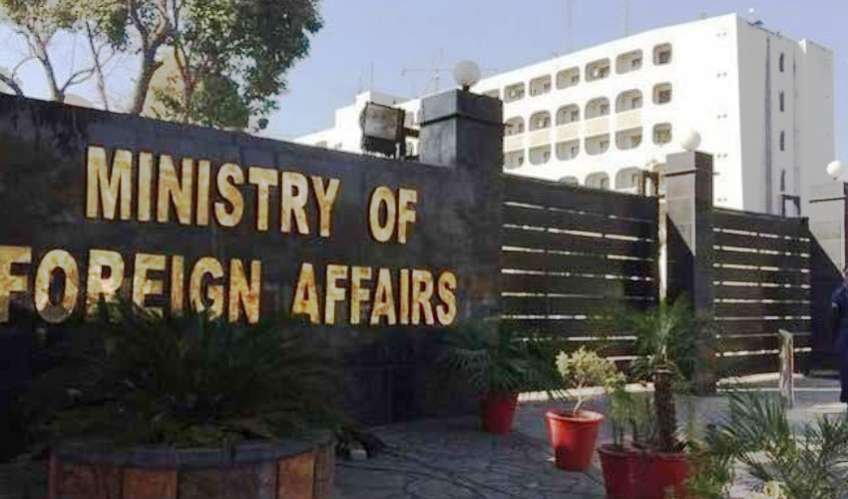

Pakistan’s Foreign Office released a detailed statement following the announcement of a ceasefire agreement with India, which came shortly after Pakistan’s retaliatory actions in response to what it described as violations of its sovereignty.
The statement clarified that while both countries had agreed to a ceasefire, it was essential to understand the sequence of events that led to this outcome. It cited the firing of BrahMos missiles across multiple points along the international border as the trigger for Pakistan’s response, which it said was executed under the right of self-defence as enshrined in Article 51 of the UN Charter.
“In light of unprovoked and unlawful Indian aggression, Pakistan was compelled to launch Operation Bunyan-ul-Marsoos early on Saturday,” the statement read. It condemned the multiple Indian strikes conducted between May 7 and 10, asserting that these attacks resulted in the loss of innocent lives, including women, children, and the elderly, and caused extensive damage to infrastructure, including religious sites.
The Foreign Office accused India of aggravating the situation by sending successive waves of drones across Pakistan, including over the federal capital. These drones, described as killer drones or loitering munitions, reportedly targeted both civilian and military infrastructure, heightening public anxiety and prompting urgent calls for a defensive response.
The statement noted that India launched multiple missile attacks on Pakistani airbases. Despite enduring what it called blatant provocations, Pakistan exercised significant restraint. However, to ensure the protection of its people, Pakistan was ultimately compelled to respond.
Pakistan emphasized that its counteraction was carefully measured, avoiding civilian casualties and focusing only on those military sites responsible for orchestrating the attacks. These included Indian airbases used to launch missile assaults on Pakistani territory. Pakistan claimed to have shared conclusive evidence with the international community to support its claims.
The Foreign Office called for greater international awareness of the underlying causes of this escalation, stating that the current crisis should not be reduced to traditional regional disputes. Instead, it urged a broader view that considers complex geopolitical rivalries and historical grievances.
It stressed that the unresolved Jammu and Kashmir conflict remains central to regional instability, exacerbated by India’s suppression of Kashmiris’ legitimate right to self-determination. It rejected the conflation of this struggle with terrorism and linked regional unrest to the residual impact of Cold War politics.
Despite past challenges, Pakistan described itself as a resilient state that has played a crucial role in the global fight against terrorism, especially after 9/11. It criticized India for attempting to exploit Pakistan’s security focus on its western borders by conducting hybrid warfare and sponsoring proxy terrorism.
According to the statement, India’s consistent attempts to portray Pakistan as the epicenter of terrorism conveniently emerge whenever Pakistan is close to eliminating this threat. This cycle, ongoing for over 20 years, must now come to an end, the statement asserted.
Pakistan warned that any distraction from its anti-terrorism efforts—particularly from the west—would endanger both regional peace and global security. It urged the international community to stop enabling India’s narrative, which it says falsely attributes regional instability to Pakistan.
The statement also cautioned that India’s strategy of externalizing internal unrest while internalizing an international dispute, namely Jammu and Kashmir, is counterproductive and destabilizing. It called on India to cease using terrorism as a pretext for advancing controversial policies such as the revocation of Kashmir’s autonomous status and undermining the Indus Waters Treaty.
Pakistan reiterated its willingness to engage in meaningful dialogue with India to resolve all outstanding issues peacefully, especially the Kashmir dispute. It appealed to the international community to take a proactive role in preventing any further escalation.
The statement concluded with a reaffirmation of Pakistan’s unwavering commitment to defend its sovereignty, vowing that all branches of national power, particularly the armed forces, are entrusted with safeguarding the nation’s territorial integrity.
Describing its military response as deliberate, restrained, and proportionate, Pakistan said it remains mindful of the catastrophic consequences that escalation between two nuclear-armed states could bring to the region and beyond. It emphasized the need for caution and responsibility moving forward.
