

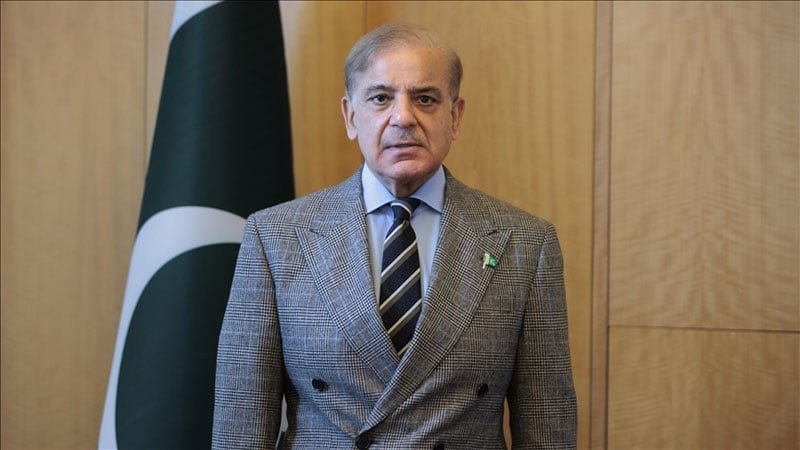

Prime Minister Shehbaz Sharif has accused India of being behind the recent attack on Pakistan by Afghan-based militants, asserting that the assault occurred while Afghanistan’s foreign minister was visiting New Delhi.
Speaking during a federal cabinet meeting in Islamabad, the prime minister said Pakistan was compelled to respond decisively after repeated provocations from Afghan soil. He emphasized that the Pakistan Armed Forces, led by Field Marshal Syed Asim Munir, acted with courage and precision to defend national sovereignty.
Pakistan Exercises Right to Self-Defence
PM Shehbaz highlighted that the attack was not an isolated incident but part of a series of terrorist assaults launched from Afghanistan, targeting police personnel, soldiers, and civilians. He said these strikes were carried out by Fitna al Khawarij militants, who continue to pose a serious threat to Pakistan’s internal security.
“Pakistan has every right to defend itself,” the prime minister stated. “Our patience has limits, and we cannot tolerate aggression against our people.”
He reaffirmed Pakistan’s commitment to self-defence under international law, emphasizing that any hostile act against the state would be met with a proportional and firm response.
Longstanding Ties With Afghanistan Tested
The prime minister underlined that Pakistan and Afghanistan share deep historical, cultural, and religious ties, yet recent hostilities have strained mutual trust. Despite these tensions, Pakistan has continued to host millions of Afghan refugees for decades, often at great economic and social cost.
“Even with limited resources, Pakistan upheld its humanitarian obligations,” he said, adding that Islamabad’s goodwill should not be mistaken for weakness.
Temporary Ceasefire and Mediation by Qatar
Shehbaz Sharif revealed that Pakistan had agreed to a 48-hour temporary ceasefire at the request of Afghanistan, with Qatar acting as a mediator to de-escalate the situation.
He praised Qatar’s Amir for offering to facilitate dialogue and help achieve a lasting peace agreement between the two neighboring countries. The prime minister reaffirmed Pakistan’s readiness to pursue peace through negotiation—but only under fair and justified conditions.
“Pakistan desires peace and progress through dialogue, not confrontation,” he said. “However, any talks must be grounded in mutual respect and accountability.”
Regional Peace and Support for Gaza
Turning to regional developments, PM Shehbaz welcomed the Gaza ceasefire achieved through diplomatic efforts led by several Islamic countries, including Pakistan, Qatar, Egypt, Saudi Arabia, the UAE, Malaysia, and Türkiye.
He described the truce as a positive step toward ending bloodshed in Gaza and restoring humanitarian access for the Palestinian people. The prime minister reiterated Pakistan’s unwavering stance on the Palestinian issue, emphasizing the need to establish a sovereign Palestinian state in line with UN resolutions.
He also reaffirmed Pakistan’s unwavering support for the people of Kashmir, underscoring the country’s long-standing position that the dispute must be resolved peacefully in accordance with international law and the aspirations of the Kashmiri people.
Economic Stability and IMF Agreement
In addition to addressing regional tensions, PM Shehbaz announced that Pakistan had successfully reached a staff-level agreement with the International Monetary Fund (IMF). He described this as a crucial milestone in Pakistan’s ongoing efforts to achieve macroeconomic stability and rebuild investor confidence.
“The IMF agreement demonstrates our government’s commitment to fiscal discipline, reform, and growth,” he said, assuring that the government would continue implementing policies aimed at economic recovery and social welfare.
Pakistan’s Message: Peace With Dignity, Defence With Resolve
Prime Minister Shehbaz Sharif concluded his remarks by emphasizing that Pakistan seeks peaceful coexistence with all its neighbors but will not hesitate to defend its sovereignty when challenged.
“Pakistan extends the hand of peace, but never at the cost of its security or dignity,” he declared.
The statement underscores Islamabad’s dual approach — combining firm defence against aggression with constructive diplomacy to promote long-term regional peace and development.
