

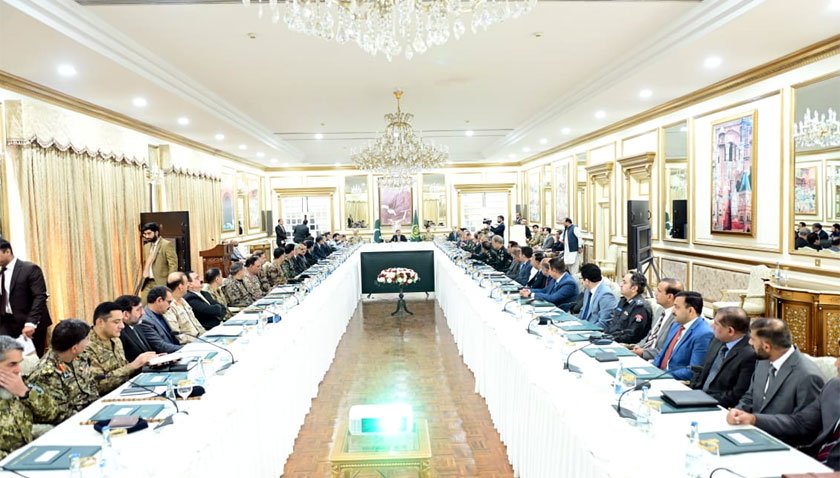

Prime Minister Shehbaz Sharif reiterated the government’s strong resolve to eliminate the outlawed Tehreek-e-Taliban Pakistan (TTP), now referred to as “Fitna al-Khawarij,” to ensure the country’s socio-economic progress and stability.
Addressing the National Action Plan (NAP) apex committee meeting in Islamabad on Friday, the prime minister emphasized that achieving Pakistan’s development goals requires not only improved law and order across the country but also a concerted effort to completely eradicate the TTP.
“The agenda of Pakistan’s progress and prosperity, which we discussed yesterday, can only be realized when all of us not only improve law and order across Pakistan but also take decisive action to eliminate the TTP,” PM Shehbaz stated.
The prime minister’s comments come amid a troubling surge in terrorist activities, particularly in the provinces of Khyber Pakhtunkhwa and Balochistan. These regions have become hotspots for attacks targeting both security forces and civilians.
Rising Toll of Terrorism
2024 has become one of the deadliest years for Pakistan’s security forces, with at least 685 personnel losing their lives in 444 terrorist incidents. The overall death toll, including both civilians and military personnel, reached 1,612, accounting for over 63% of total fatalities last year. This marks a staggering 73% increase in losses compared to the 934 militants killed during the same period. The fatalities in 2024 are the highest in nine years, surpassing the previous year’s figures by more than 66%, with an average of nearly seven lives claimed every day.
The surge in violence has put immense pressure on the government to address the growing threat posed by the banned group and restore peace to the affected regions.
Call for Unified Action
PM Shehbaz urged all relevant stakeholders, including the federal government, provincial authorities, and security forces, to collaborate in developing a comprehensive strategy to combat terrorism. He expressed confidence that through unity in thought and action, the government would effectively implement plans to address the nation’s security challenges.
The prime minister also acknowledged the presence of terrorist elements in Khyber Pakhtunkhwa and Balochistan, which aim to destabilize the country. He pointed out that these groups often receive “external support,” contributing to the ongoing violence.
In light of recent clashes with Afghan forces along the border, PM Shehbaz confirmed that a “befitting response” had been delivered by Pakistani security forces.
Designating TTP as Fitna al-Khawarij
In July, the government officially designated the TTP as “Fitna al-Khawarij” and instructed all institutions to refer to those responsible for terrorist acts against Pakistan as “khariji” (outcasts). This move marked a significant step in the government’s efforts to isolate the terrorist group and delegitimize its actions.
Addressing Digital Misinformation
PM Shehbaz also addressed the growing issue of misinformation and disinformation on digital media platforms, underscoring the importance of tackling this challenge to combat terrorism and extremism effectively. He pointed out that certain foreign elements were using social media to spread harmful narratives against Pakistan, exacerbating the country’s image problems.
The prime minister stressed that distorted facts and manipulated realities circulating on social media were raising doubts that undermined the credibility of the state. “If we don’t counter this challenge, all our efforts to eliminate terrorism and extremism will go to waste,” he warned.
Despite these challenges, PM Shehbaz expressed confidence that the government would successfully address the issues and continue working toward a secure and prosperous future for Pakistan.
