

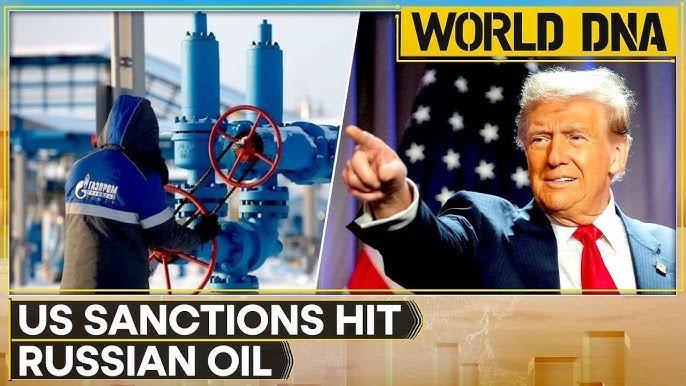

Russian President Vladimir Putin has maintained a defiant stance following the United States’ imposition of fresh sanctions on two of Russia’s largest oil producers — Rosneft and Lukoil. The measures, announced by US President Donald Trump, have already caused a ripple effect in global markets, pushing oil prices up by nearly 5% and signaling heightened economic pressure on Moscow amid the ongoing war in Ukraine.
The sanctions have led to immediate disruptions in energy trade, with Chinese state-owned oil companies suspending purchases of Russian crude in the short term. Similarly, Indian refiners, who have emerged as major buyers of seaborne Russian oil, are expected to significantly cut imports. Together, Rosneft and Lukoil account for over 5% of global oil production, making the sanctions a major blow to Russia’s export sector.
The move represents a dramatic policy reversal by President Trump, who only last week had indicated plans to meet Putin in Budapest to discuss potential solutions to end the conflict in Ukraine.
Moscow’s Response and Global Reactions
In response, President Putin described the sanctions as an “unfriendly act” and dismissed their potential impact on the Russian economy. “This is, of course, an attempt to put pressure on Russia. But no self-respecting country and no self-respecting people ever decide anything under pressure,” Putin stated during a televised address.
President Trump, when asked about Putin’s comments, replied, “I’m glad he feels that way. That’s good. I’ll let you know about it in six months from now.” Later, he cancelled the planned Budapest summit, citing that it would not achieve the “desired outcome.”
Meanwhile, Ukraine’s President Volodymyr Zelenskiy welcomed the sanctions, calling them “very important,” but emphasized that more international pressure is necessary to compel Moscow toward a ceasefire. In a further escalation, Putin warned that Russia’s response to any long-range missile strikes inside its territory would be “very serious, if not overwhelming.”
Adding to the mounting pressure, the European Union adopted its 19th package of sanctions, including a ban on Russian liquefied natural gas (LNG) imports and restrictions targeting Chinese refiners and Central Asian banks accused of aiding Moscow’s energy trade.
Despite Putin’s confidence, Russia’s oil and gas revenues — which make up roughly a quarter of its state budget — have dropped 21% year-on-year, underlining the growing strain on the country’s war-driven economy.
