

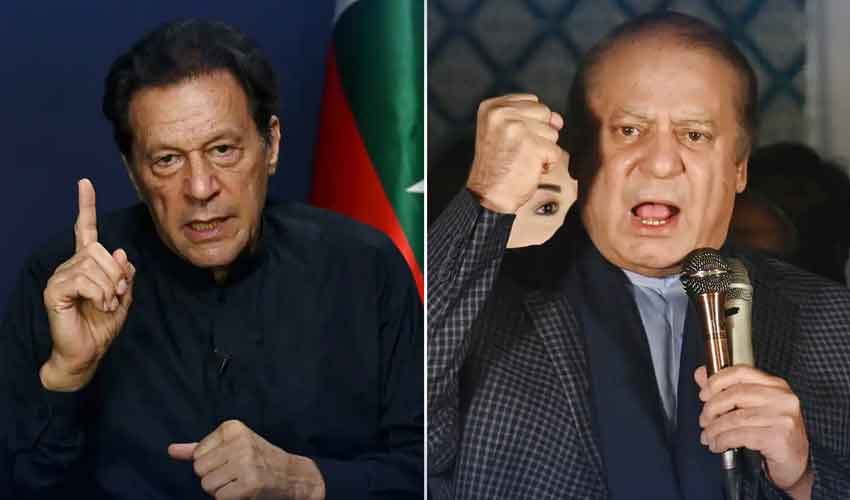

Nawaz-Imran Meeting
Adviser to the Prime Minister, Rana Sanaullah, has firmly dismissed recent media reports suggesting that Pakistan Muslim League-Nawaz (PML-N) President Nawaz Sharif met or sought a meeting with Pakistan Tehreek-e-Insaf (PTI) founder Imran Khan at Adiala Jail.
Speaking on Samaa TV’s programme Mere Sawal with Absar Alam, Sanaullah described such claims as baseless and inappropriate, asserting that Nawaz Sharif is a seasoned statesman who would not engage in such theatrics.
Rana Sanaullah emphasized that the country’s political leadership, despite its history of internal friction, is now more aligned than ever in addressing Pakistan’s ongoing challenges. “The political leadership and the establishment are united in resolving the crisis,” he said. “We have emerged stronger on the global stage and proven our capability to the world.”
Reflecting on PML-N’s previous term in office, Sanaullah stated that from 2013 to 2018, the party governed under significant constraints. “We were not allowed to act freely,” he noted. “Even so, we succeeded in tackling many of the country’s fundamental problems.” He added that Pakistan is currently in a relatively stronger position, both domestically and internationally.
According to the adviser, Pakistan’s political system now faces a unique opportunity. “Everyone wants to help; this is the time to take charge of our future,” he said. He stressed the importance of advancing national defense and strengthening the economy, promising that those responsible for Pakistan’s current condition would be held accountable.
Rana Sanaullah also discussed the need to strengthen democratic institutions, particularly Parliament. “Civil institutions acknowledge Parliament as the supreme authority,” he said, adding that while progress has been made, further steps are needed to empower democratic governance.
He called for moving beyond political grudges and focusing on national progress. “We should accept the current progress and move forward rather than dwelling on the past,” he urged. “Even I have had political disagreements, but now is the time to look ahead.”
Regarding political harmony, Sanaullah admitted that divisions within political forces continue to hinder a stable parliamentary system—a problem he said dates back to 2011. “No one is obstructing progress,” he remarked, “but the lack of unity is a serious challenge.”
He highlighted Prime Minister Shehbaz Sharif’s efforts to engage the opposition, noting that the premier had invited opposition members for dialogue on three occasions. “Everything Shehbaz Sharif has done has been with Nawaz Sharif’s approval,” he clarified.
Criticizing the rumors about a jail meeting between Nawaz Sharif and Imran Khan, Rana Sanaullah said such speculation was disrespectful. “Nawaz Sharif is a senior politician. It is inappropriate to claim that he would visit Adiala Jail to meet Imran Khan,” he said.
Sanaullah also addressed concerns regarding the recent increase in parliamentarians’ salaries, pointing out that while the adjustment was overdue—having been delayed for nine years—there are still disparities between the pay scales of lawmakers, ministers, and top officials across various departments. He insisted that the Speaker or Senate Chairman should not be solely blamed for this disparity, adding that broader institutional reforms are needed to address such issues across public and private sectors.
Meanwhile, PTI leadership has also denied any formal initiative from Nawaz Sharif for reconciliation or talks with Imran Khan. The party clarified that it would only respond to an official proposal from Nawaz Sharif or the PML-N. According to PTI insiders, no such proposal has been presented, and the matter would be discussed with the party’s founding chairman when appropriate.
PTI also cast doubt on the sincerity of any outreach from the ruling party, citing ongoing concerns over political engineering, manipulation of reserved seats, and what it described as attempts to suppress opposition representation. “Genuine dialogue cannot take place while the ruling party continues efforts to sideline its opponents,” a party source remarked.
The statements from both sides indicate that while overtures of dialogue have been floated, deep-rooted political mistrust and unresolved grievances continue to obstruct any real movement toward reconciliation.
