

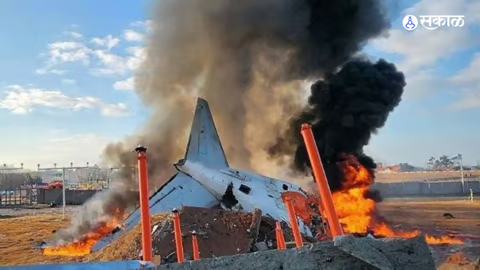

South Korea’s acting President Choi Sang-mok has ordered an emergency safety inspection of the country’s entire airline system following the deadliest air disaster in the nation’s history. Investigators are working to identify the victims and determine the cause of the crash, which claimed the lives of 179 people.
A Jeju Air Boeing 737-800, carrying 175 passengers and six crew members, crashed on Sunday morning at Muan International Airport after a belly landing and skidding off the runway, exploding upon impact with a wall. Two crew members survived the crash.
At a disaster management meeting in Seoul, Choi emphasized that the immediate priority is identifying the victims, providing support to their families, and treating the two survivors. “We ask officials to transparently disclose the investigation process and promptly inform the bereaved families,” Choi said. He also called for an urgent safety inspection of the entire airline operation system to prevent future accidents.
The transport ministry is considering a special inspection of all 101 Boeing 737-800 aircraft operated by South Korean airlines. Jeju Air flight 7C2216, arriving from Bangkok, Thailand, was attempting to land at Muan International Airport when the crash occurred just after 9 a.m. on Sunday.
Investigators are examining bird strikes and weather conditions as potential factors in the crash. Initial reports indicated that the aircraft, powered by CFM 56-7B26 engines, appeared to be traveling at high speed and its landing gear was not down as it skidded across the runway. The pilots had reported a bird strike and declared a mayday shortly before the crash.
Officials are also investigating the role of the localizer antenna at the end of the runway, which aids in landing, and the embankment on which it was positioned. Many of the victims were local residents returning from holidays in Thailand, with two Thai nationals among the dead.
On Monday, investigators continued working to identify the remaining victims, as families anxiously waited at Muan airport. Park Han-shin, who lost his brother in the crash, spoke of the emotional difficulty in waiting for identification, calling for unity among the families to support each other through the disaster recovery.
The wreckage, which was largely destroyed by flames, is still being sifted through by emergency workers. Although the flight data recorder has been recovered, it sustained some damage, and it is unclear whether the data is intact enough for analysis.
While Muan airport remains closed until Wednesday, other airports in the country, including Incheon International Airport, continue to operate as scheduled.
Jeju Air’s shares fell to a record low on Monday, dropping as much as 15.7%. In line with international aviation rules, South Korea is leading a civil investigation into the crash, with assistance from the U.S. National Transportation Safety Board (NTSB), which is sending a team of investigators. Boeing and the Federal Aviation Administration (FAA) are also involved.
Choi, who took over as acting president just three days ago following the impeachment of the president and prime minister, is overseeing the recovery efforts and the investigation.
