

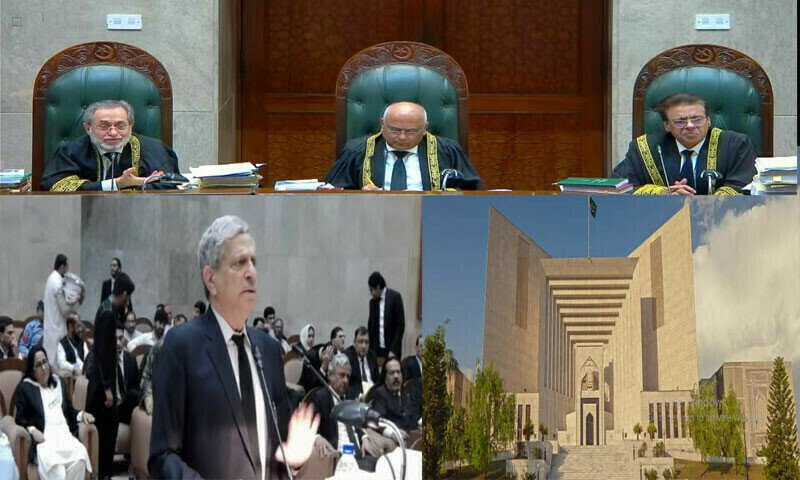

ISLAMABAD: The Supreme Court of Pakistan continued hearings on Thursday in a pivotal constitutional case regarding the allocation of reserved seats, as arguments unfolded against the Election Commission of Pakistan’s (ECP) decision to deny the PTI its share of these seats.
An 11-member full bench, headed by Chief Justice Aminuddin Khan, presided over the session, which was live-streamed on the Supreme Court’s official YouTube channel—a rare instance of judicial transparency in a high-profile case.
Representing PTI leader Kanwal Shauzab, senior lawyer Salman Akram Raja began his submissions by offering condolences to Justice Jamal Mandokhail over the recent passing of his mother. Citing precedents such as the Sindh High Court Bar ruling and the Supreme Court’s judgment invalidating emergency powers during the Musharraf era, Raja argued that the Court retains the authority to strike down unconstitutional actions.
He maintained that under Section 66 of the Elections Act, party documentation alone is sufficient for nomination, and that no third-party verification is required. When questioned by Justice Muhammad Ali Mazhar about evidentiary support, Raja confirmed that all required documents had been submitted and that a judicial majority had accepted them.
Justice Mandokhail pressed whether this interpretation reflected the majority opinion, to which Raja affirmed it did—though he admitted he had not read the full text due to time constraints.
Members of the bench expressed skepticism about inconsistencies in the PTI candidates’ declarations of party affiliation. Justice Musarrat Hilali questioned why only a fraction of candidates confirmed their PTI ties. Chief Justice Aminuddin noted that only 39 candidates explicitly declared their affiliation, while Justice Mandokhail suggested the rest could have submitted affidavits. Raja insisted that all necessary documents were filed, affirming the candidates’ connection to the party.
Justice Hasan Azhar Rizvi inquired about PTI’s formal actions as a political entity following the ECP’s December 24 declaration that it no longer qualified as a political party. Raja responded that the matter centered on that controversial ECP decision and said it had been challenged.
The bench also scrutinized PTI’s internal elections. When asked about their legitimacy, Raja asserted they were valid and accused the ECP of misinterpreting Rule 94 to strip PTI of its electoral symbol and its reserved seats.
Justice Hilali asked why PTI didn’t hold fresh intra-party elections. Raja replied that they did, but these too were disputed. He emphasized that the party was denied its symbol on December 22, and its list of reserved seat nominees was rejected the following day—leaving little time for legal recourse before the nomination deadline.
Justice Mandokhail noted the ECP had no PTI lists on file, while Raja argued the commission had refused to accept them, forcing PTI to publish the lists online and turn to the Lahore High Court. He said a court order issued on February 2 was only made available on February 7—just a day before the general elections—leaving the party unable to act in time.
Raja further alleged that the ECP unlawfully allocated PTI’s reserved seats to other political parties.
As he wrapped up, senior lawyer Hamid Khan appeared before the court seeking to present arguments. However, Chief Justice Aminuddin pointed out that the hearings were concluding and Khan, who had been on leave since June 23, would be the third counsel—prompting the bench to deny his request for adjournment.
The hearing continues as the Supreme Court deliberates on one of the most consequential electoral disputes in recent memory.
