

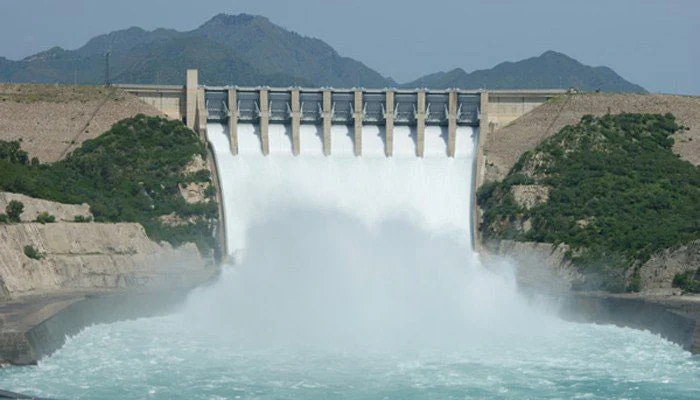

Tarbela Dam has reached its maximum conservation level of 1550 feet above mean sea level. The reservoir now holds 5.728 million-acre feet (MAF) of live water storage, a milestone that carries significant importance for Pakistan’s water and energy needs.
According to the Water and Power Development Authority (WAPDA), this achievement marks a positive development for the country’s irrigated agriculture and hydropower generation. The dam has been a cornerstone of Pakistan’s socio-economic growth for the past five decades. It ensures water availability for crops during crucial periods, helps manage flood risks, and generates affordable hydroelectric power.
Key Role of Tarbela Dam in Pakistan’s Development
Since its completion, Tarbela Dam has played a vital role in meeting agricultural and energy demands. It stores water during the monsoon and gradually releases it to irrigated regions across the country. This controlled supply has supported food security while also protecting communities from devastating floods.
Additionally, Tarbela is one of the largest hydropower facilities in the region. Its low-cost hydel electricity significantly reduces the reliance on expensive imported fuels, strengthening the energy sector.
Current River Inflows and Outflows
The current inflows and outflows at major rivers, reservoirs, and barrages provide an updated snapshot of Pakistan’s water resources.
Rivers:
Indus at Tarbela: Inflows 268,300 cusecs, Outflows 238,900 cusecs
Kabul at Nowshera: Inflows 44,600 cusecs, Outflows 44,600 cusecs
Khairabad Bridge: Inflows 258,100 cusecs, Outflows 258,100 cusecs
Jhelum at Mangla: Inflows 38,600 cusecs, Outflows 7,000 cusecs
Chenab at Marala: Inflows 67,600 cusecs, Outflows 49,000 cusecs
Barrages:
Jinnah: Inflows 325,800 cusecs, Outflows 319,400 cusecs
Chashma: Inflows 403,500 cusecs, Outflows 351,600 cusecs
Taunsa: Inflows 485,000 cusecs, Outflows 479,700 cusecs
Guddu: Inflows 439,100 cusecs, Outflows 417,700 cusecs
Sukkur: Inflows 363,500 cusecs, Outflows 315,400 cusecs
Kotri: Inflows 129,200 cusecs, Outflows 125,800 cusecs
Trimmu: Inflows 79,400 cusecs, Outflows 68,300 cusecs
Panjnad: Inflows 70,500 cusecs, Outflows 56,300 cusecs
Reservoirs:
Tarbela: Minimum operating level 1402 feet, present level 1550 feet, live storage 5.728 MAF
Mangla: Minimum operating level 1050 feet, present level 1217.45 feet, live storage 5.423 MAF
Chashma: Minimum operating level 638.15 feet, present level 643.30 feet, live storage 0.094 MAF
The inflows and outflows at Tarbela, Jinnah, Chashma, Nowshera, and Mangla are calculated as mean flows over 24 hours. The rest of the flows are gauged at 6:00 a.m.
Significance of Full Storage Levels
Reaching maximum conservation levels means that Pakistan is better prepared to meet water demands for agriculture. It also strengthens the energy grid by ensuring continuous hydropower generation. As climate change continues to affect rainfall patterns, efficient water management at reservoirs like Tarbela, Mangla, and Chashma becomes even more critical.
The filling of Tarbela Dam to its maximum capacity marks a milestone in Pakistan’s water and energy management. With stable inflows, effective regulation, and strong reservoir levels, the dam continues to safeguard agriculture, reduce flood risks, and deliver affordable hydropower to millions of people.
