

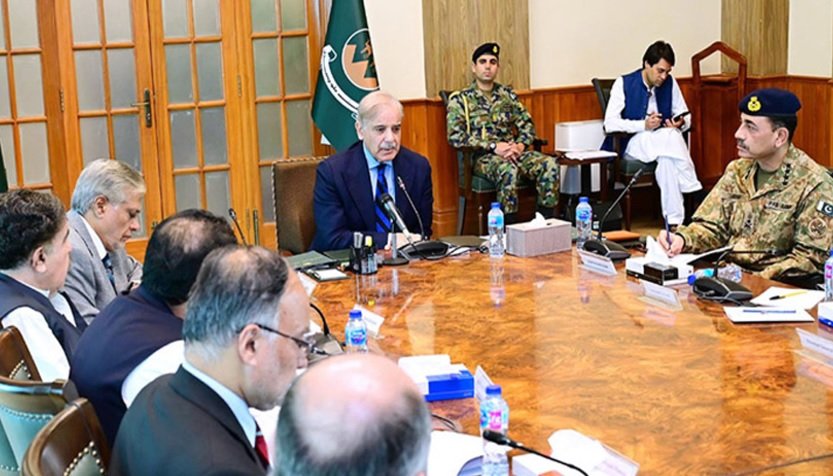

ISLAMABAD: Amid a surge in militant attacks in Balochistan, the Apex Committee—a joint civil-military body—formally approved a comprehensive military operation on Tuesday to target terrorist organizations operating in the region.
According to a statement from the Prime Minister’s Office, the committee sanctioned the operation against groups such as the Majeed Brigade, BLA, BLF, and BRAS, which have been involved in attacks on civilians and foreign nationals. These groups are accused of undermining Pakistan’s economic progress and security at the behest of hostile external powers.
The decision comes in response to an alarming rise in terror attacks, including a recent deadly suicide bombing at Quetta’s railway station earlier this month, which killed at least 27 people and injured over 60 others.
The Federal Apex Committee of the National Action Plan convened in Islamabad under the chairmanship of Prime Minister Shehbaz Sharif on November 19, 2024. The meeting focused on “Reinvigorating Pakistan’s Counter-Terrorism (CT) Campaign.” Participants included provincial chief ministers, Chief of Army Staff General Syed Asim Munir, federal cabinet members, and senior government officials.
The attendees were briefed on the evolving security challenges and the measures being undertaken to address terrorism, law and order issues, sub-nationalism, religious extremism, and crime-terror nexus. Other topics discussed included combating disinformation campaigns and addressing broader socio-economic challenges, according to the statement.
The committee stressed the importance of a “unified political voice and cohesive national narrative” in tackling these complex issues. It emphasized the need for political support across party lines and a national consensus to reinvigorate the counter-terrorism campaign under the framework of Vision Azm-e-Istehkam.
To strengthen the counter-terrorism infrastructure, the meeting agreed to revitalize the National Counter-Terrorism Authority (NACTA) and establish National and Provincial Intelligence Fusion and Threat Assessment Centers.
The civil-military leadership adopted a “whole-of-system” approach, integrating diplomatic, political, informational, intelligence, socio-economic, and military measures to counter terrorism effectively. Specific focus was placed on enhancing coordination between federal and provincial governments, as well as among relevant institutions and ministries.
Additionally, the committee decided to form District Coordination Committees under provincial apex committees to ensure the seamless implementation of directives from federal and provincial governments.
