

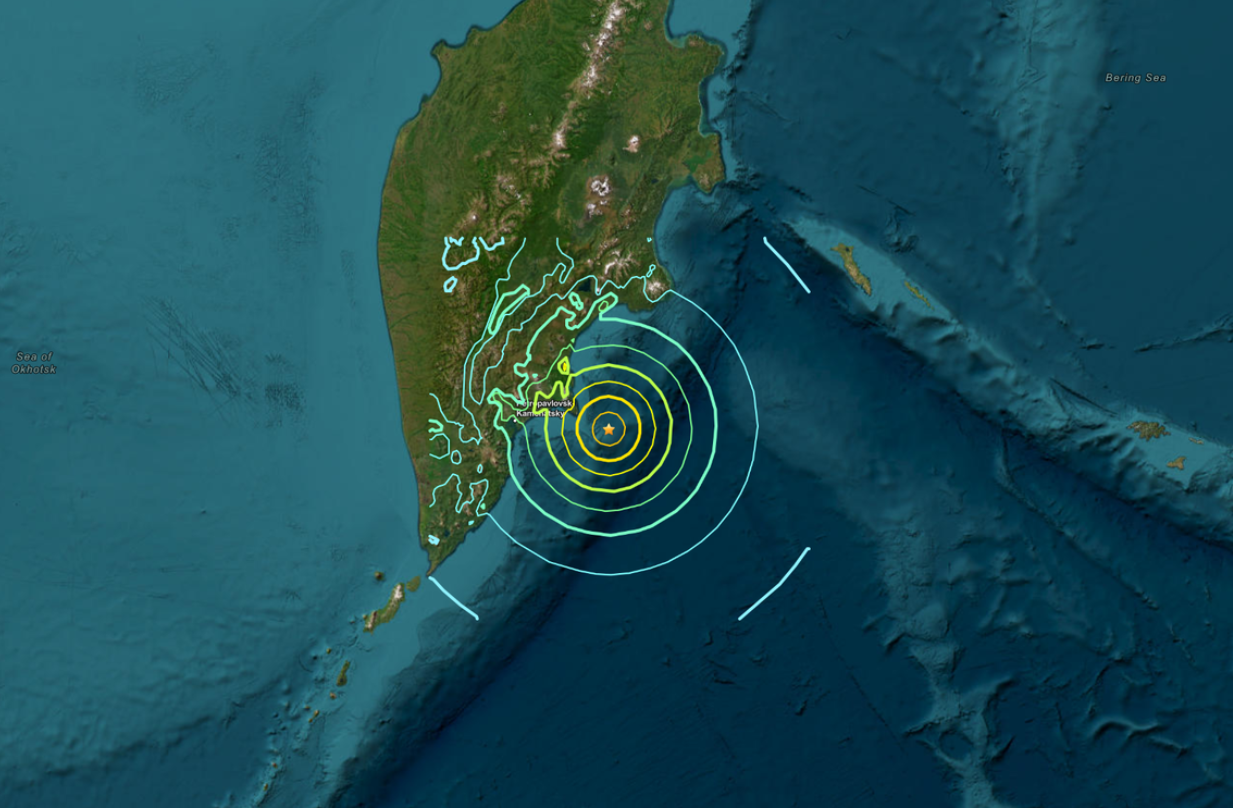

A tsunami alert has been triggered following three powerful Russia Pacific coast earthquakes recorded near the city of Petropavlovsk-Kamchatsky on Sunday. Among the tremors, the strongest measured 7.4 in magnitude, as reported by the United States Geological Survey (USGS), and was accompanied by two more quakes registering magnitudes of 6.7 and 5.0 respectively.
The epicenter of these Russia Pacific coast earthquakes was approximately 140 kilometers east of Petropavlovsk-Kamchatsky, the capital city of the Kamchatka region. This remote city, with a population exceeding 160,000, sits on the seismically active Kamchatka Peninsula—an area well-known for tectonic volatility due to its location at the junction of the Pacific and North American plates.
All three Russia Pacific coast earthquakes occurred within a short 32-minute span, and the 7.4-magnitude quake struck at a shallow depth of 20 kilometers (12 miles), intensifying the shaking on the surface. Fortunately, there have been no immediate reports of injuries or structural damage.
Following the quakes, the US National Tsunami Warning Center issued a tsunami threat for certain parts of Russia’s eastern coastline. A separate tsunami watch that had been initially issued for Hawaii was eventually withdrawn, alleviating broader Pacific concerns.
Germany’s seismic monitoring agency, GFZ, also confirmed the seismic activity, initially logging a magnitude 6.7 quake but later upgrading it to 7.4, aligning with USGS data.
The Russia Pacific coast earthquakes occurred in one of the world’s most active seismic zones. Kamchatka has a long history of devastating quakes. Notably, in 1952, the peninsula was struck by a magnitude 9.0 quake, which, although it did not claim lives locally, sent tsunami waves as high as 9.1 meters (30 feet) crashing into Hawaii.
Sunday’s earthquakes serve as a stark reminder of the region’s vulnerability. The Russia Pacific coast earthquakes struck near Petropavlovsk-Kamchatsky, a city located far northeast of Japan and across the Bering Sea from the U.S. state of Alaska. This geographical positioning places it directly over converging tectonic plates, making it prone to major seismic events.
While emergency teams continue to monitor the area, seismologists warn that aftershocks are possible following large-scale seismic activity like these Russia Pacific coast earthquakes. Local authorities are urging residents to remain alert and follow updates from official channels.
The frequency and magnitude of these Russia Pacific coast earthquakes underscore the importance of preparedness in high-risk zones. With tectonic shifts inevitable, regional emergency response teams are staying vigilant for any further seismic developments.
