


US President Donald Trump has indicated that Ukrainian President Volodymyr Zelenskyy may be responsible for Moscow’s invasion of Ukraine, stating he could have avoided the war. Trump also suggested he would “probably” meet with Russian President Vladimir Putin this month.
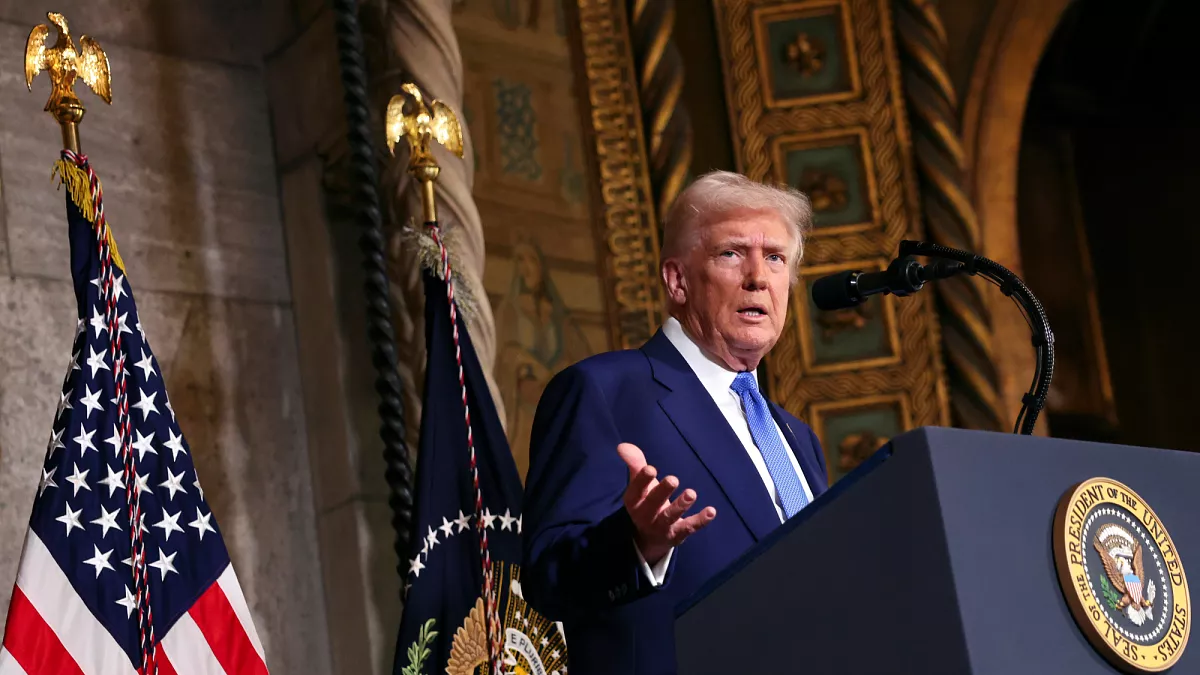
In a news conference held at his Mar-a-Lago estate in Palm Beach, Florida, Trump reacted to reports that Ukraine had been excluded from talks aimed at ending the conflict. He dismissed complaints from Kyiv, saying, “You’ve been there for three years. You should have ended it… You should have never started it. You could have made a deal. I could have made a deal for Ukraine.”
Trump also expressed confidence in his ability to broker a deal, saying he was “much more confident” about reaching an agreement after recent talks between US Secretary of State Marco Rubio and Russian Foreign Minister Sergey Lavrov in Saudi Arabia. He added, “Russia wants to do something, they want to stop the savage barbarism.”
When asked about the possibility of supporting Russia’s call for elections in Ukraine as part of a peace deal, Trump claimed—without evidence—that Zelenskyy had a low approval rating of just 4 percent and pointed out that elections had been suspended under martial law. However, a December poll conducted by the Kyiv International Institute of Sociology found that 52 percent of Ukrainians trusted Zelenskyy, though this was a decrease from earlier in the year.
Trump further commented, “When you want a seat at the table… Wouldn’t the people of Ukraine have to say like, ‘It’s been a long time since we’ve had an election?’” He added that his stance reflected the views of other countries as well.
Zelenskyy, in response to Trump’s remarks, emphasized that Ukraine must be included in any decision-making regarding the war. He stressed, “No decision can be made without Ukraine on how to end the war in Ukraine,” during a visit to Turkey.
In Riyadh, US and Russian officials, including Rubio and Lavrov, agreed to form high-level teams to work on a path to end the conflict as soon as possible. US National Security Advisor Mike Waltz also noted that discussions would likely involve territorial issues and post-conflict security guarantees.
As concerns grow that Trump may offer significant concessions to Moscow to reach a deal, European leaders are divided on how to respond. UK Prime Minister Keir Starmer has expressed willingness to send peacekeeping troops to Ukraine, while French President Emmanuel Macron indicated he might consider sending troops to areas outside conflict zones. German Chancellor Olaf Scholz dismissed talks of post-war security forces as “highly inappropriate,” and Polish Prime Minister Donald Tusk said his country would not send troops to Ukraine.
France is set to host European leaders for a second round of talks on the issue, after an emergency summit on Monday failed to achieve a unified position.
During his news conference, Trump expressed support for the idea of European peacekeepers, but made it clear that US troops would not be involved. “If they want to do that, that’s great, I’m all for it,” Trump said.
