

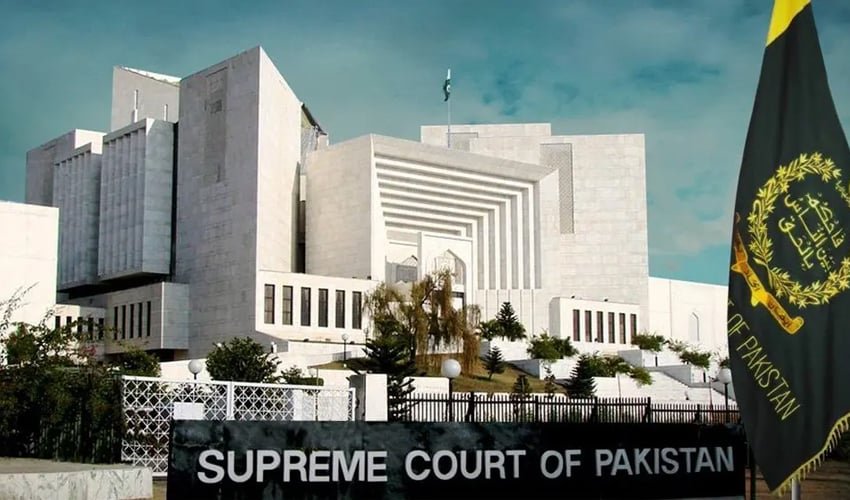

The Army Act can be invoked against civilians who attack military installations or steal property belonging to the armed forces, said Khawaja Haris, legal counsel for the Ministry of Defence, during Supreme Court proceedings on Monday.
Haris made this statement while presenting his rebuttal in the case concerning the annulment of civilian trials in military courts. A seven-member constitutional bench, led by Justice Aminuddin Khan, is hearing the matter. Other members of the bench include Justices Jamal Khan Mandokhail, Musarrat Hilali, Muhammad Ali Mazhar, Hasan Azhar Rizvi, Naeem Akhtar Afghan, and Shahid Bilal.
Haris argued that the Pakistan Army Act empowers the military to detain civilians involved in offences such as damaging military property or attacking installations. However, Justice Mazhar pointed out that filing a First Information Report (FIR) is a legal requirement before any arrest can be made. Justice Rizvi emphasized that individuals taken into custody must be presented before a magistrate.
Justice Mandokhail raised important procedural concerns, asking, “How is a case initiated? Who conducts the investigation? What is the procedure? We need clarity.” He added that under Section 2(d) of the Army Act, a person can only be considered an accused after being formally charged.
In response, Haris cited constitutional provisions that allow for a separate jurisdiction governing court martial proceedings. He also referenced past rulings, including those issued by former Chief Justice Saeed-uz-Zaman Siddiqui, to support his position. He noted that several judicial precedents exist upholding the legitimacy of military courts.
Haris further argued that it is the legislature’s responsibility to determine the appropriate forum for trials. However, Justice Mandokhail countered by stating that it falls to the judiciary to evaluate whether such trials align with constitutional principles.
He stressed that the court is not tasked with assessing whether a ruling would lead to more or less terrorism, remarking, “Countering terrorism is the duty of the parliament, not the judiciary.”
When Haris asserted that military courts do not fall under Article 175 of the Constitution, Justice Mandokhail asked under which constitutional clause such courts operate.
The hearing was adjourned until Tuesday, with Khawaja Haris scheduled to continue his rebuttal.
