

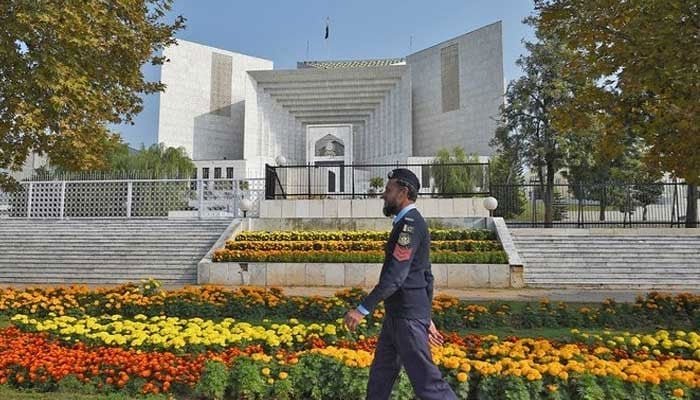

Defection Clause Verdict
ISLAMABAD: The federal government, alongside the Pakistan Peoples Party (PPP), has expressed support for the Supreme Court Bar Association’s (SCBA) plea for a review of the Supreme Court’s verdict concerning Article 63-A, delivered in May 2022.
This verdict asserted that dissident members of a parliamentary party are prohibited from casting votes that contradict their party’s directives.
The SC’s larger bench, led by Chief Justice Qazi Faez Isa, convened on Tuesday to deliberate on the review petition. The newly formed bench includes Justices Amin-ud-Din Khan, Jamal Khan Mandokhail, Mazhar Alam Khan Miankhel, and Naeem Akhtar Afghan.
This reconstitution of the bench occurred after Justice Munib Akhtar expressed his inability to participate, citing issues related to the bench’s formation by the Practice and Procedure Committee.
Chief Justice Isa had previously postponed the hearing due to Justice Munib’s absence, indicating that he would be invited to rejoin the bench. However, Justice Munib maintained his position regarding his non-participation in a bench constituted by the aforementioned committee, arguing that it violated established procedures.
Following the recent amendments to the Supreme Court (Practice and Procedure) Ordinance 2024, Justice Munib was replaced by Justice Amin-ud-Din Khan on the bench.
In his correspondence, Justice Munib emphasized that the matter of forming a bench for the review petition appeared unexpectedly on the committee’s agenda, despite the committee having convened multiple times previously.
He also raised concerns about including Justice Mazhar Alam Miankhel in the current bench, pointing out that he had dissented in the previous ruling.
The crux of the current review stems from a reference filed by the Pakistan Tehreek-e-Insaf (PTI) government in 2022, which sought the Supreme Court’s opinion on Article 63(A) to mitigate the issue of defections within parliamentary ranks.
The court’s ruling, decided by a narrow 3-2 majority, established guidelines prohibiting lawmakers from opposing their party’s directives when voting.
The SCBA’s plea contests the ruling’s interpretation, specifically challenging the paragraph that states the votes of dissident lawmakers should not be counted.
The association argues that while dissidents can be disqualified, their votes should still be acknowledged in accordance with the Constitution, highlighting that the Supreme Court’s opinion contradicts constitutional principles and constitutes unwarranted interference.
Article 63(A) plays a pivotal role in the disqualification of lawmakers due to defection. It stipulates that a lawmaker can be disqualified for voting against their parliamentary party’s directives, particularly in critical votes such as electing the prime minister or chief minister, votes of confidence or no-confidence, and money bills or constitutional amendments.
The article mandates that the party leader must provide a written declaration confirming a lawmaker’s defection, giving them an opportunity to explain their stance before proceeding with disqualification.
The ongoing review and its implications are crucial for the stability of Pakistan’s parliamentary democracy, especially in light of previous conflicts arising from defections and political maneuvering. As discussions continue, the outcome of this review may significantly influence the legislative landscape and the functioning of political parties in Pakistan.
