

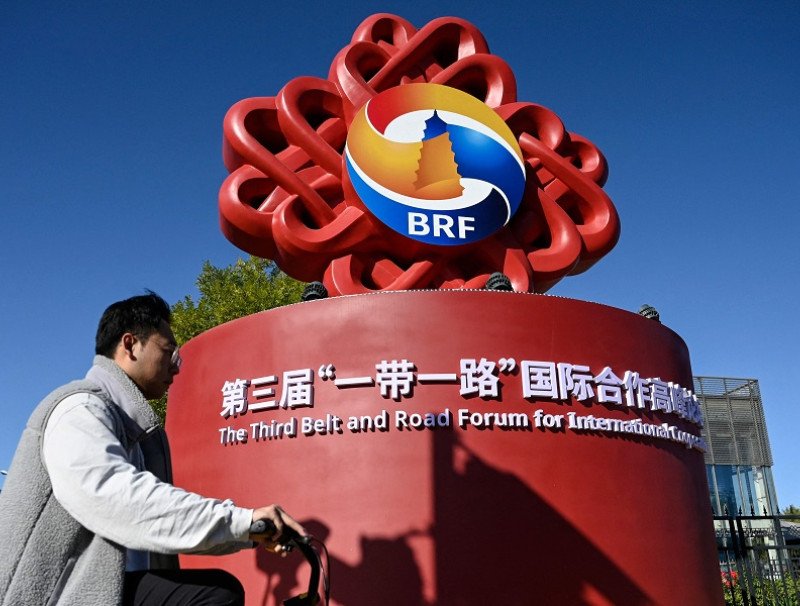

China made preparations on Monday to host the third Belt and Road Initiative (BRI) Forum in Beijing on Tuesday with representatives from 130 countries.
In comparison with the recent G20 meeting in India, the BRI Forum has emerged as the most powerful platform for development as 130 countries are attending it.
The event, focusing on China’s Belt and Road Initiative (BRI), takes place amidst the backdrop of the Israel-Gaza conflict.
The international community is increasingly turning to an assertive Beijing to aid in de-escalating the violence.
Among the prominent figures invited to the BRI forum, Russia’s President Vladimir Putin takes center stage, marking his first significant global engagement since the Ukraine invasion that isolated his regime on the international stage.
Leaders have started arriving in the Chinese capital to partake in a celebratory event marking a decade of the BRI, a flagship project championed by President Xi Jinping to expand China’s global influence. While China aspires to elevate its status as a leading global power through this forum, the Israel-Gaza conflict remains the dominant headline.
Israel declared war against the Islamist group following a series of incursions where their fighters breached the heavily fortified border on October 7, resulting in the deaths of over 1,400 individuals, with the majority being civilians, due to shootings, stabbings, and burnings.
Amid intense Israeli airstrikes on the Hamas-governed Gaza Strip, over one million people have been displaced, leading to scenes of chaos and despair. These bombings have claimed the lives of at least 2,670 people in Gaza, primarily civilians, and have leveled entire neighborhoods.
China’s Foreign Minister Wang Yi has criticized Israel for actions that he deems “beyond the scope of self-defense” and has called for an end to the “collective punishment of the people of Gaza.” This represents China’s most forceful stance yet on the conflict.
Western officials have criticized Beijing for not explicitly naming Hamas in its statements regarding the Israel-Gaza conflict. Wang engaged in discussions with US Secretary of State Antony Blinken, who urged China to use its influence in the Middle East to advocate for peace.
China maintains a close relationship with Iran, whose clerical leadership supports both Hamas and Hezbollah, the Lebanese militant group that could potentially open a second front against Israel. Earlier this year, China played a mediating role in bringing together historical rivals Iran and Saudi Arabia.
Beijing’s special envoy, Zhai Jun, is set to visit the Middle East this week to promote a ceasefire in the Israel-Hamas conflict and advance peace talks, as reported by China’s state broadcaster, CCTV. However, specific countries to be visited were not disclosed.
Niva Yau, a nonresident fellow with the Atlantic Council’s Global China Hub, suggests that this summit offers Beijing an opportunity to frame its attendance as a gesture of support for its stance on the matter.
