


Egypt and Turkey also ended their differences and exchanged ambassadors in order to restore their diplomatic ties today.
On Tuesday, the Egyptian and Turkish foreign ministries said their countries have upgraded their relations to the ambassador level.
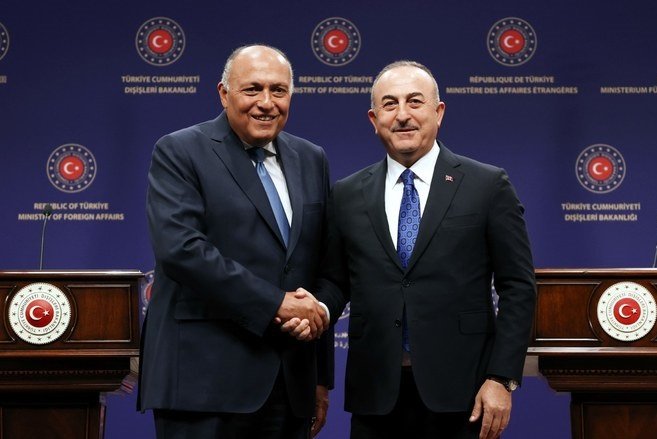
Egyptian Foreign Minister Sameh Shoukry has conducted a meeting with his Turkish counterpart, Mevlut Cavusoglu, in Ankara, signaling significant progress in the restoration of full diplomatic relations between the two countries after almost ten years.
This visit marks Shoukry’s second trip to Turkey this year, while Cavusoglu previously visited Egypt in March.
During a joint news conference, Cavusoglu stated that concrete steps were being taken to elevate diplomatic relations to the highest level, hinting at the imminent appointment of ambassadors.
The strained relations between Egypt and Turkey can be traced back to the 2013 coup that led to the overthrow of former Egyptian President Mohamed Morsi.
In the past, tensions between the two nations increased as antigovernment protests intensified in Egypt.
Turkish President Recep Tayyip Erdogan
Turkish President Recep Tayyip Erdogan called on Egyptian President Hosni Mubarak to heed the people’s demands shortly before Mubarak was overthrown during the Egyptian revolution in February.
Erdogan later visited Egypt as part of a tour of countries affected by the Arab Spring in September. The relations continued to strengthen when Mohamed Morsi, a member of the Muslim Brotherhood, was democratically elected as Egypt’s president.
Erdogan’s AK Party and the Muslim Brotherhood were perceived to share ideological similarities, and during Erdogan’s subsequent visit to Egypt, a loan agreement was signed, solidifying the positive rapport between the two nations.
However, following Morsi’s ousting in a military coup, relations took a drastic turn. Diplomatic ties were downgraded to the level of charge d’affaires, with Erdogan condemning the coup leader, Abdel-Fattah el-Sisi, as an “illegitimate tyrant.”
In response, Cairo declared Turkey’s ambassador persona non grata. Turkey gradually became a safe haven for Egyptian exiles, including senior Muslim Brotherhood leaders and opposition media outlets. Erdogan even adopted a hand gesture popularized during anti-coup protests in Egypt.
Additionally, Egypt and Turkey found themselves at odds with each other and Greece in a tense dispute over maritime boundaries in the Eastern Mediterranean, specifically regarding the rights to search for and exploit natural gas reserves.
However, both countries engaged in exploratory talks in May and September, aiming to restore bilateral relations as regional alliances shifted following the resolution of the Gulf crisis involving Turkey’s ally, Qatar, on one side, and Saudi Arabia, the United Arab Emirates, Bahrain, and Egypt on the other.
In February, Sameh Shoukry visited Turkey to show solidarity after devastating earthquakes claimed numerous lives. This visit marked the first time an Egyptian official had traveled to Turkey in a decade. In March, Mevlut Cavusoglu reciprocated the gesture by making a one-day visit to Egypt, highlighting the ongoing efforts to mend ties between Ankara and Cairo, marking the first visit by a senior Turkish official to Egypt in the past ten years.
