

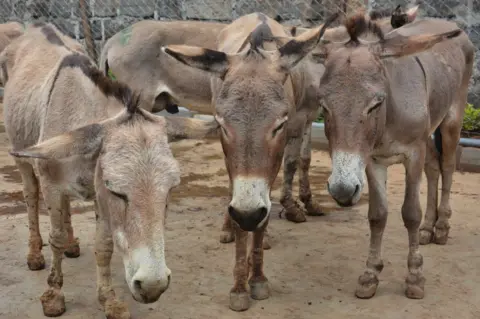

A donkey slaughterhouse has commenced operations in Gwadar, Balochistan, with a Chinese company overseeing its management. The Ministry of Food Security disclosed this development during a meeting of the National Assembly’s Standing Committee on Food Security.
Officials confirmed that an agreement has been finalized with China for the export of donkey hides and bones, marking a new phase in Pakistan’s trade relations. While committee members questioned why live donkeys were not being exported instead, ministry representatives clarified that shipping live animals poses logistical and regulatory challenges.
The ministry further revealed that there is growing interest from investors in establishing similar slaughterhouses across Pakistan, with discussions underway with additional Chinese companies for potential collaborations.
Committee member Rana Muhammad Hayat highlighted the decline in donkey usage within Pakistan due to the rise of motorized transport. He emphasized the need for breeding programs to enhance the quality of the donkey population, ensuring a sustainable supply for export purposes.
The launch of this facility is part of broader efforts to expand Pakistan’s livestock trade, tapping into China’s high demand for donkey-derived products. Donkey hides are particularly valuable in the Chinese market, where they are used in traditional medicine.
However, the establishment of the slaughterhouse has sparked debates over ethical concerns and economic feasibility. Critics argue that instead of slaughtering donkeys, Pakistan should explore alternative means of leveraging the donkey population for economic benefits. Others see the move as an opportunity to strengthen trade ties with China and boost local employment.
As Pakistan seeks to expand its livestock export sector, the success of the Gwadar facility may determine the future of similar projects across the country.
