

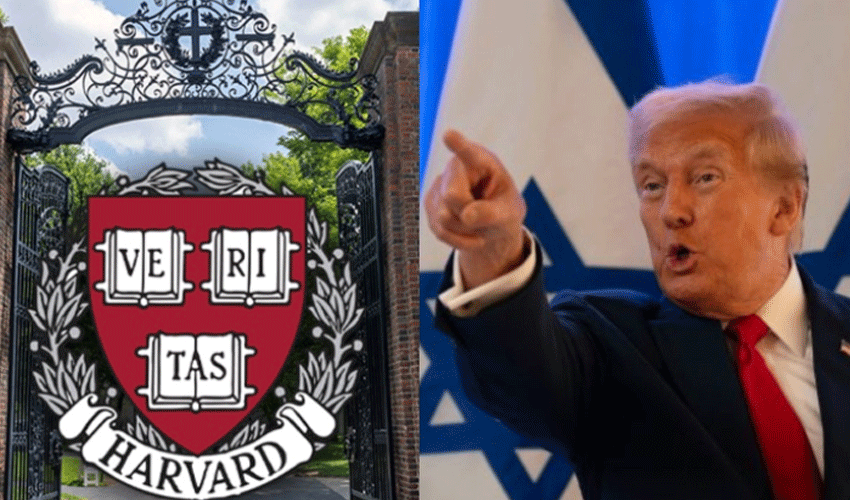

The Trump administration on Monday imposed a freeze on approximately $2.3 billion in federal funding allocated to Harvard University, following the institution’s formal refusal to comply with a list of sweeping demands from the White House. These demands focused on student activism, institutional governance, and diversity initiatives.
The move escalates the ongoing tensions between top U.S. universities and the federal government over pro-Palestinian protests linked to the Israel-Gaza conflict and mounting accusations of antisemitism on campuses.
Last week, the White House sent Harvard a letter outlining ten measures it deemed necessary to counter antisemitism. These included enforcing “viewpoint diversity” across departments, reporting students accused of opposing American values, dismantling diversity, equity, and inclusion (DEI) programs, and appointing an external monitor to audit university departments.
In a defiant response, Harvard President Alan Garber criticized the demands as an overreach of federal authority, calling them an attempt at “direct governmental regulation of the intellectual conditions” within the university. He asserted that Harvard would not compromise its independence or constitutional rights, stating that the responsibility for addressing institutional shortcomings rests with the university community.
Soon after Garber’s letter was published, the U.S. Department of Education announced the suspension of $2.2 billion in grants and $60 million in contracts. The department accused Harvard of displaying “a troubling entitlement mindset” common among elite universities and emphasized that continued federal support depends on meaningful institutional change.
The freeze marks the first time a major university has openly rejected directives from the current administration. Columbia University, previously penalized with a $400 million funding cut, eventually accepted similar terms. Other prestigious institutions—such as Princeton, Brown, and the University of Pennsylvania—are also under review.
President Donald Trump has repeatedly criticized U.S. universities for failing to take sufficient action against antisemitic behavior, especially after widespread student protests in response to the war in Gaza and Washington’s support for Israel. In December 2023, then-Harvard president Claudine Gay resigned following controversy over her testimony on antisemitism and allegations of plagiarism.
In March, the administration disclosed that it was reviewing $256 million in existing contracts with Harvard and evaluating up to $8.7 billion in multi-year commitments. Monday’s announcement represents the first major action resulting from that review.
Garber defended Harvard’s stance, arguing that the administration’s demands were “unmoored from the law” and violated First Amendment protections. While reaffirming the university’s commitment to addressing antisemitism, he rejected the notion that federal power should dictate educational direction.
The funding freeze has sparked polarized reactions. Senator Bernie Sanders condemned the move, accusing Trump of authoritarian behavior and praising student resistance. Civil rights organizations expressed concern over threats to academic freedom, while faculty members initiated legal action claiming the federal government was misusing financial leverage to influence internal university policies and suppress free expression.
Among the rejected demands were disciplinary action against students involved in past demonstrations and the revocation of recognition for certain student groups. The White House warned that further defiance could jeopardize nearly $9 billion in total federal aid.
In a statement, the Department of Education’s task force on antisemitism described Harvard’s response as “deeply disappointing” and pledged to pursue further measures if needed.
As of Monday evening, Harvard maintained its position. “We are committed to fostering a safe, inclusive, and intellectually vibrant campus,” Garber said. “But these principles cannot be dictated by government edict.”
