

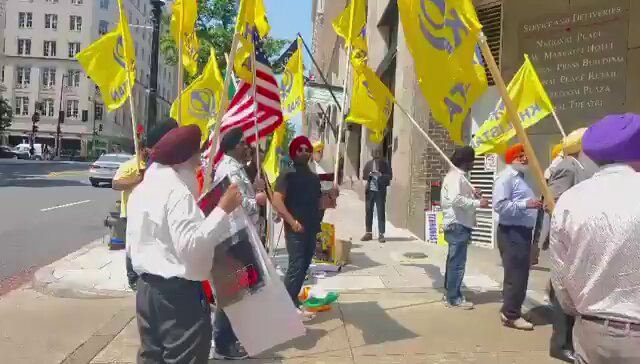

Washington, D.C: An Indian parliamentary delegation, led by Congress leader Shashi Tharoor, was surrounded and heckled by Sikh separatist protesters upon their arrival in Washington, D.C., on Tuesday. The delegation had been traveling through Guyana, Panama, Colombia, and Brazil before reaching the U.S. capital for the final leg of their diplomatic tour.
Videos shared on social media platforms depicted protesters waving flags associated with the Khalistan movement and chanting slogans as the delegation arrived at the National Press Building. The demonstrators expressed strong opposition to the Indian government’s policies, particularly concerning Sikh rights and autonomy.
In response to the escalating situation, members of the Indian delegation sought refuge in a nearby parking area and refrained from engaging with the media. They also requested assistance from local law enforcement to ensure their safety.
The delegation’s visit to Washington was part of a broader diplomatic outreach initiated by the Indian government following the April 22 Pahalgam terror attack in Indian-administered Jammu and Kashmir, which resulted in the deaths of 26 civilians. In retaliation, India launched Operation Sindoor, targeting alleged terrorist camps in Pakistan and Pakistan-administered Kashmir. The operation led to a series of military confrontations between the two nuclear-armed nations, culminating in a ceasefire agreement brokered by the United States on May 10.
During their visit, the Indian delegation engaged with U.S. lawmakers, think tanks, and media outlets to present India’s perspective on the conflict and to counter what they described as misinformation campaigns by Pakistan. Shashi Tharoor emphasized that India’s military actions were targeted at terrorist infrastructure and not at the civilian population. He also highlighted concerns about the treatment of minorities in Pakistan, particularly Sikhs, and called for international attention to these issues.
The delegation’s outreach efforts coincide with a similar initiative by Pakistan. Former Pakistani Foreign Minister Bilawal Bhutto-Zardari led a high-level parliamentary delegation to New York, where he presented Pakistan’s stance on the recent military confrontations and challenged India’s narrative at the United Nations.
The diplomatic activities of both nations underscore the ongoing tensions and the complex geopolitical dynamics in the region. As the situation develops, international observers continue to monitor the interactions between India and Pakistan, both bilaterally and within multilateral forums.
