

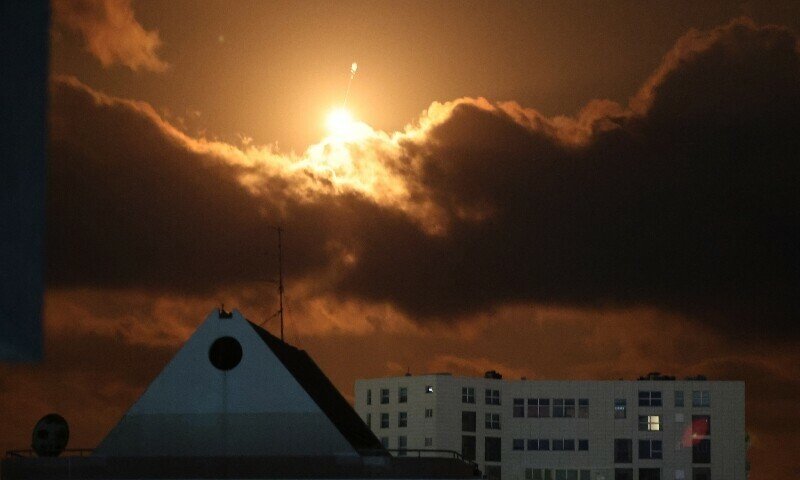

Fresh Missile Strikes
Tensions between Iran and Israel surged further on Wednesday as both nations exchanged fresh waves of missile attacks, deepening a conflict that has now entered its sixth day. The crisis has raised international alarm, with U.S. President Donald Trump issuing a stern call for Iran’s “unconditional surrender,” fueling speculation over potential U.S. military involvement.
Israel launched extensive airstrikes targeting Iran’s nuclear facilities, military bases, and even civilian residences last Friday. The assault, part of Israel’s operation codenamed Rising Lion, reportedly killed several top Iranian commanders, nuclear scientists, and civilians. Israel claims the campaign is a direct response to Iran’s nuclear ambitions—allegations Tehran denies, insisting its uranium enrichment program is strictly for peaceful purposes.
In response, Iran launched multiple barrages of missiles toward Israel early Wednesday, including advanced hypersonic Fattah-1 missiles. Explosions were reported over Tel Aviv.
Simultaneously, the Israeli military issued evacuation orders to residents near Tehran to prepare for targeted strikes on Iranian military installations. Explosions were reported in Tehran and Karaj, with Iranian media confirming widespread damage.
The Iranian Revolutionary Guard Corps (IRGC) claimed responsibility for what it called the 11th phase of “Operation Honest Promise 3,” asserting it now has “complete control” over Israeli airspace—a claim strongly contested by Tel Aviv.
Casualties continue to mount. Human Rights Activists, a Washington-based group, reported a total of 585 deaths in Iran, including 239 civilians, while the Iranian Health Ministry confirmed 224 deaths and over 1,000 injuries. Israel has reported 24 deaths, mostly civilians.
Tensions spiked further when Trump posted on Truth Social: “We now have completely and total control of the skies over Iran.” His cryptic language has drawn criticism and confusion, with observers questioning the extent of U.S. involvement.
Although Trump claims the U.S. is not directly engaged, he warned Tehran of “severe consequences” if U.S. assets were targeted. He also issued a veiled threat against Iran’s Supreme Leader, Ayatollah Ali Khamenei, adding, “We know exactly where he is hiding… not taking him out, at least not for now.”
Trump convened his National Security Council on Tuesday to evaluate U.S. strategy. Meanwhile, members of Congress have responded sharply. Republican Thomas Massie and Democrat Ro Khanna introduced a War Powers Resolution to block U.S. involvement, echoing concerns raised by progressives like Rashida Tlaib and Alexandria Ocasio-Cortez. According to a recent Economist/YouGov poll, 60% of Americans oppose U.S. involvement in the war.
Despite U.S. denials, military movements tell a different story. American F-16s, F-22s, F-35s, and Stratofortress B-52 bombers have been deployed across the region, with many stationed in Diego Garcia. The Pentagon describes the deployments as “defensive,” aimed at intercepting drones and projectiles.
The conflict has significantly weakened Iran’s leadership structure. Israeli strikes reportedly killed key advisers to Ayatollah Khamenei, prompting Iranian authorities to ban officials from using mobile phones and digital communications amid fears of surveillance and cyberattacks. Iranian media reported that Israel also launched a major cyber offensive against the country’s infrastructure.
Amid the growing chaos, the U.S. announced the temporary closure of its embassy in Jerusalem. “Given the security situation… the U.S. Embassy in Jerusalem will be closed from June 18 through June 20,” read a statement posted online.
Meanwhile, the International Atomic Energy Agency (IAEA) confirmed that Israeli strikes had hit underground enrichment halls at Iran’s Natanz facility. Although Israel has declared it now controls Iranian airspace, military analysts doubt it can destroy deeply buried sites like Fordow without U.S. assistance—prompting speculation that Trump may authorize bunker-buster bombs or allow U.S. aircraft to refuel Israeli jets for long-range missions.
Global markets are reacting nervously. Attacks on critical infrastructure, including South Pars—the world’s largest gas field shared by Iran and Qatar—have rattled oil prices, signaling broader economic fallout if the conflict expands further.
As both sides dig in, and with Washington’s rhetoric hardening, the Middle East appears dangerously close to a broader regional war, with the world watching anxiously.
