


Israel has postponed the release of over 600 Palestinian prisoners, citing Hamas’ “humiliating ceremonies” during hostage handovers, Israeli Prime Minister Benjamin Netanyahu announced on Sunday.
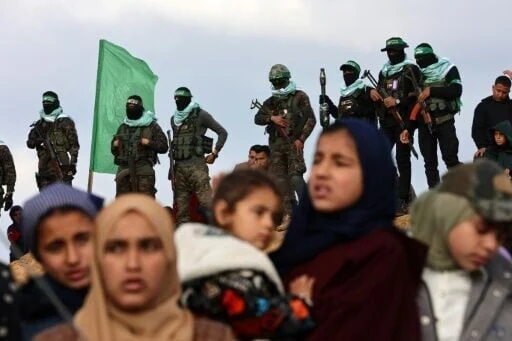
Since the ceasefire took effect on January 19, Hamas has freed 25 Israeli hostages in carefully orchestrated handovers where masked militants paraded captives and had them wave to gathered crowds in Gaza.
On Saturday, in the seventh exchange under the truce deal, Hamas released six Israeli hostages. However, Israel delayed its scheduled prisoner release, prompting Hamas to call the move a “blatant violation” of the agreement.
“In response to Hamas’ repeated violations—such as degrading ceremonies that disrespect our hostages and their use for propaganda—it has been decided to delay the planned release of terrorists until the next hostages are freed without such displays,” Netanyahu’s office stated.
US Warns Hamas of Consequences
US Secretary of State Marco Rubio cautioned that Hamas would be “destroyed” if it failed to release all remaining hostages.
In the Israeli-occupied West Bank and Gaza Strip, families of Palestinian detainees waited anxiously for their relatives’ release on Saturday.
“Waiting is extremely difficult,” said Shireen al-Hamamreh, whose brother was set for release. “But we will remain strong, God willing,” she told AFP in Ramallah.
Hamas Accuses Israel of Violating Truce
The Palestinian Prisoners’ Club advocacy group said 620 inmates, most of them from Gaza, were supposed to be freed on Saturday.
Before Israel’s announcement, Hamas spokesperson Abdel Latif al-Qanou criticized the delay, stating it “constitutes a blatant violation of the agreement.” He urged mediators to press Israel to comply with the terms without obstruction.
Tensions Rise Over Hostage Deaths
The delay follows emotional days in Israel, where forensic experts confirmed that the remains of hostage Shiri Bibas had been returned after an initial mix-up.
Netanyahu accused Hamas of violating the truce by mishandling the remains, vowing that the group would pay “the full price.”
Bibas and her two young sons were among the hostages taken on October 7, 2023, during Hamas’ attack on Israel, which sparked the ongoing war. Hamas initially claimed the Bibas family had died in an Israeli airstrike, but Israeli forensic teams found no evidence of blast injuries.
The Final Hostage Swap Under the First Phase
The six Israeli hostages released on Saturday were the last expected to be freed under the truce’s first phase, which has so far secured the return of 30 captives.
Negotiations for a second phase, which aims to establish a permanent ceasefire, have yet to begin.
In a highly publicized event in Nuseirat, central Gaza, hostages Eliya Cohen, 27, Omer Shem Tov, 22, and Israeli-Argentine Omer Wenkert, 23, stood on stage, flanked by Hamas militants, before being handed to the Red Cross.
Under the rain in Rafah, southern Gaza, militants transferred Tal Shoham, 40, and Avera Mengistu, 38, who appeared dazed.
The final hostage, Hisham al-Sayed, 37, a Bedouin Muslim, was quietly handed over and taken back to Israel. Sayed and Mengistu had been held in Gaza for nearly a decade after separately entering the territory.
Hostage Death Controversy
On Thursday, Hamas returned the first group of deceased hostages, sparking outrage in Israel after forensic analysis determined that Shiri Bibas’ remains were not among them.
Hamas later admitted to a possible “mix-up of bodies” and returned additional remains on Friday, which the Bibas family confirmed as hers.
The Israeli military later claimed that Hamas had killed Bibas’ sons, Ariel and Kfir, “with their bare hands” in November 2023. Hamas dismissed the accusation as “baseless lies.”
Casualties and the Ongoing War
Out of the 251 people taken hostage during Hamas’ October 2023 attack, 62 remain in Gaza, including 35 the Israeli military believes are dead.
The attack resulted in 1,215 Israeli deaths, mostly civilians, according to an AFP tally based on Israeli official data.
In response, Israel launched a military offensive that has killed at least 48,319 people in Gaza, the majority civilians, according to figures from Gaza’s health ministry, which the United Nations considers reliable.
