


Israeli Director
Israeli director Yuval Abraham, co-creator of the Oscar-winning documentary No Other Land, has strongly criticized the Academy of Motion Picture Arts and Sciences for its silence following the assault and detention of Palestinian co-director Hamdan Ballal.
Ballal was attacked by Israeli settlers and soldiers in his home village of Susya in the occupied West Bank, an incident that has sparked widespread condemnation from the global film community.
Abraham pointed out that while the European Film Academy and numerous other international organizations publicly expressed support for Ballal and condemned the attack, the U.S. Academy remained silent.
Despite appeals from several members of the Academy, particularly within the documentary branch, no official statement was released. Abraham believes this lack of response indicates a disregard for the challenges faced by filmmakers working under occupation.
The incident occurred on March 24, 2025, during Ramadan, when a group of masked Israeli settlers, some armed, stormed Ballal’s home while he was having his evening meal. Reports indicate that Israeli soldiers participated in the attack, during which Ballal sustained head injuries.
While he was receiving medical assistance in an ambulance, Israeli forces forcibly removed him, blindfolded him, and detained him overnight for interrogation. He was released the following day without charges, but the violent nature of the attack has raised serious concerns about the safety of Palestinian artists and filmmakers documenting the realities of life under occupation.
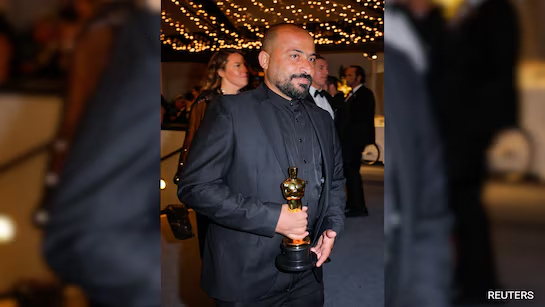
Ballal, along with Abraham, Basel Adra, and Rachel Szor, co-directed No Other Land, a documentary that sheds light on the struggles of Palestinian communities in Masafer Yatta, an area frequently targeted by Israeli military and settler actions.
The film won the Academy Award for Best Documentary Feature in March 2025, earning international acclaim for its powerful storytelling and documentation of systemic displacement and violence.
The Academy’s failure to respond to the attack on Ballal has drawn criticism from various quarters, with activists, filmmakers, and human rights organizations calling for a formal statement condemning the assault. Many argue that the Academy’s silence is inconsistent with its commitment to supporting filmmakers facing censorship, persecution, or violence.
Abraham stressed that issuing a statement would not only demonstrate solidarity with Ballal but also send a meaningful message to the global film community.
He argued that taking a stand could help prevent similar attacks in the future by increasing international scrutiny on the treatment of Palestinian artists and storytellers. The lack of action, he warned, could be perceived as complicity in the ongoing oppression of voices that challenge the dominant narrative.
The broader debate surrounding the Academy’s silence reflects ongoing discussions about the responsibility of major film institutions in addressing human rights violations and political oppression.
For many, this case serves as yet another example of the selective advocacy seen within Hollywood and the global entertainment industry, where certain issues receive attention while others are ignored.
