

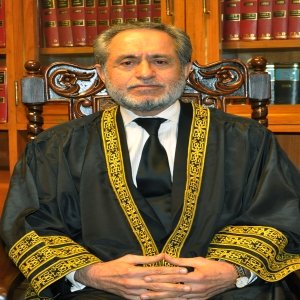

Supreme Court Justice Jamal Khan Mandokhail has raised concerns over the differing legal treatment of attacks on key state institutions, questioning why an attack on the General Headquarters (GHQ) is tried in military courts, while assaults on Parliament and the Supreme Court are handled by anti-terrorism courts (ATCs).
His remarks came during Monday’s hearing on an intra-court appeal challenging the trial of civilians in military courts. A seven-member constitutional bench, led by Justice Aminuddin Khan, is hearing the case, with former chief justice Jawad S. Khawaja’s lawyer, Khawaja Ahmad, presenting arguments.
Legal Debate Over Military Trials
Ahmad argued that civilians cannot be subjected to court-martial under any circumstances, contending that military courts do not fulfill the criteria for a fair trial. He pointed out that the five judges who ruled in an earlier case had varying opinions on the transparency of military trials.
He also questioned whether there was a clear distinction between a terrorist, a spy aiding an enemy, and an ordinary civilian in such cases.
Justice Hasan Azhar Rizvi advised Ahmad to refine his argument, to which the lawyer responded that he was not defending any accused individuals but maintaining that, had court-martial for civilians always been possible, the 21st Constitutional Amendment would not have been needed.
Justice Rizvi clarified that the amendment had expanded the Army Act to include specific crimes. Ahmad countered that if the amendment was unnecessary, then the court must declare it so.
Constitutional Amendments and Legal Scope
Justice Mandokhail observed that the 21st Amendment had excluded political parties from its provisions and that the primary issue before the court was determining who falls under the jurisdiction of the Army Act.
Ahmad further highlighted that the amendment also modified Article 175, and that military courts do not allow bail until a verdict is reached.
Justice Rizvi noted that military courts are designed for expedited trials, often concluding cases within 15 days, making bail irrelevant. He added that decisions from these courts can be appealed through independent forums, ensuring legal recourse for the accused.
While acknowledging that the Army Act is well-structured, Ahmad insisted that its applicability needs clarification, warning that allowing military trials for civilians would violate human rights.
After hearing the arguments, the Supreme Court adjourned the proceedings until tomorrow.
