

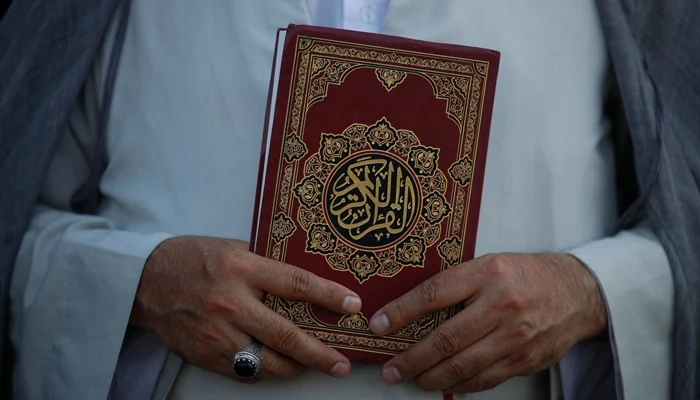

LONDON: A man who burned a copy of the Holy Quran outside the Turkish consulate in London has been convicted of a religiously aggravated public order offence, sparking debate over free speech and the boundaries of religious sensitivity.
Hamit Coskun, 50, was fined £240 by Westminster Magistrates’ Court on Monday after being found guilty of disorderly conduct for shouting profanities against Islam while holding the burning book during a protest in February.
Judge John McGarva stated that while burning a religious text may be offensive, it is not inherently disorderly. However, the judge said Coskun’s use of abusive language and the deliberate choice of time and location — outside a diplomatic mission — made his actions provocative and hostile toward a religious group.
“You were motivated, at least in part, by hostility towards followers of Islam,” the judge noted. “Your actions were highly provocative and accompanied by offensive language directed at a religion.”
Coskun, whose background includes Kurdish and Armenian heritage, denied the charge and claimed his protest was aimed at the Turkish government, not Islam. During the incident, he was physically attacked by a bystander wielding a knife.
Prosecutors stressed that Coskun was not charged for burning the Quran itself, but for the disorderly manner in which the act was carried out.
“This case is not about prosecuting an individual for burning a book,” said Philip McGhee of the Crown Prosecution Service. “It is about public disorder and abuse in a sensitive setting.”
The National Secular Society, which supported Coskun’s legal defence, criticised the verdict, calling it a “serious blow to freedom of expression.” The opposition Conservative Party echoed this sentiment, accusing the court of effectively reintroducing a blasphemy law that was formally abolished in England in 2008.
“Britain has no blasphemy laws. Yet this verdict creates one in practice,” the party said in a statement on X. “This decision is wrong and undemocratic.”
The case has reignited debate in the UK over the limits of free speech, especially when it intersects with religion and public order.
