

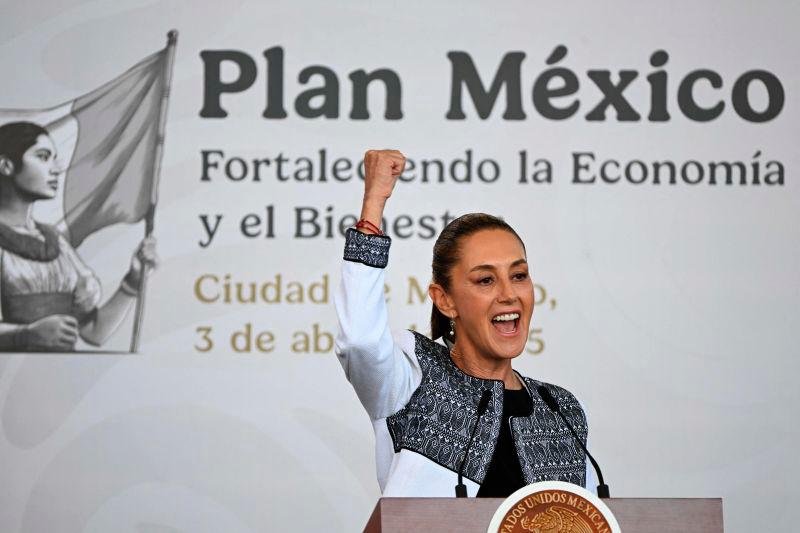

President Sheinbaum
President Claudia Sheinbaum of Mexico has welcomed her country’s exclusion from the latest wave of U.S. import tariffs, which came into effect on Thursday under President Donald Trump’s administration.
The newly imposed measures include a 25 percent duty on foreign-made cars and light trucks, sparking concern across global markets. However, Mexico, one of the United States’ top trading partners, was spared from the tariffs—a move Sheinbaum attributed to strong diplomatic relations between the two governments.
“We were spared because of the good relationship our government has with the U.S. administration,” Sheinbaum told reporters. She emphasized the importance of continued cooperation and open dialogue in navigating the turbulent landscape of international trade.
Her remarks came amid growing fears that the new tariffs could severely impact Mexico’s economy, particularly its automotive sector, which is heavily dependent on exports to the United States.
Mexico’s economic integration with the U.S. runs deep, especially under the framework of the United States-Mexico-Canada Agreement (USMCA). More than 80 percent of Mexico’s exports are directed toward the U.S., with the automotive industry accounting for a significant portion.
Approximately three million vehicles are exported from Mexico to the United States each year. International auto manufacturers such as Ford, General Motors, BMW, Volkswagen, and Toyota have established major production facilities in Mexico, reinforcing the country’s role as a key player in North American manufacturing.
While the exemption under the USMCA shielded many Mexican-made vehicles and components from the new tariffs, the impact of the policy shift is already being felt.
Stellantis, which operates plants in Toluca and Saltillo, Mexico, announced it would pause production of Dodge and RAM trucks. Additionally, the company plans to shut down its Chrysler plant in Windsor, Canada—highlighting the ripple effects of U.S. trade decisions on the broader region.
Mexico’s Economy Secretary, Marcelo Ebrard, praised the continued implementation of the USMCA as a “major achievement.” He stressed that the agreement remained intact despite the new tariff impositions and reiterated Mexico’s commitment to preserving and enhancing trade relations with the United States.
Ebrard also confirmed ongoing negotiations aimed at securing favorable terms for critical sectors such as automobiles, steel, and aluminum.
Looking ahead, President Sheinbaum expressed hope that the scope of the USMCA could be expanded to cover all Mexican exports, thereby offering greater protection against future trade disruptions.
In response to the evolving economic landscape, her administration is preparing to unveil a comprehensive “Mexico Plan”—a strategic initiative aimed at strengthening the domestic economy and supporting industries vulnerable to external pressures.
As trade tensions persist, Mexico appears determined to protect its economic interests through diplomacy, proactive planning, and deeper regional cooperation.
