

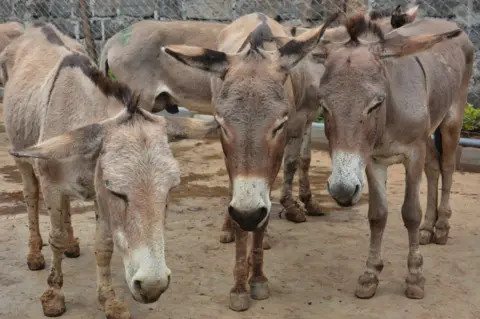

ADDIS ABABA, Ethiopia — Nearly six million donkeys are killed annually to meet the growing demand for ejiao, a traditional Chinese medicine made from donkey skins, according to a UK-based charity. The practice is having devastating consequences for communities in Africa that depend on the animals for daily life.
The Donkey Sanctuary reported on Thursday that the surge in demand is driven by China’s booming ejiao industry — valued at $6.8 billion — which uses collagen extracted from donkey hides and markets the product as a health supplement.
With China’s donkey population plummeting from 11 million in 1992 to just 1.5 million in 2023, the country has increasingly turned to Africa to satisfy its supply needs.
Last year, the African Union imposed a 15-year ban on donkey slaughter across the continent in response to rapidly declining populations and growing concerns about animal welfare and rural livelihoods.
“The ejiao industry drives a massive global trade in donkey skins, much of it illegal,” The Donkey Sanctuary said in its report, estimating that 5.9 million donkeys were slaughtered worldwide in 2024 alone. That figure is expected to rise, with projected demand for skins reaching at least 6.8 million by 2027.
The rising market value of donkeys has also made them targets for organized crime.
“Traders exploit vulnerable people using large and sophisticated networks to pressure owners into selling their animals,” the charity said. “Illegal networks operate across the continent, often without consequences, stealing and slaughtering donkeys at night.”
Many donkeys die in cruel and unregulated conditions, with others perishing in transit to slaughterhouses.
The impact is particularly harsh on rural African communities — especially women and children — who rely on donkeys for farming, water collection, and transporting goods to market.
The Donkey Sanctuary also highlighted the public health risks posed by the unregulated trade. “Transporting untreated skins and improperly disposing of carcasses can spread infectious diseases and harm local ecosystems,” the charity warned.
