

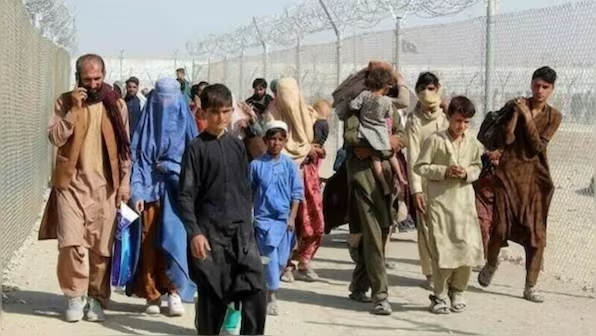

Registered Afghan Refugees
ISLAMABAD: The Supreme Court of Pakistan is set to resume hearings on a public interest petition challenging the mass deportation of Afghan refugees.
The petition, scheduled for review by a seven-judge constitutional bench headed by Justice Aminuddin Khan, was filed by a coalition of civil society activists, including former senators Farhatullah Babar and Mushtaq Ahmad, human rights advocate Amna Masood Janjua, and lawyers Jibran Nasir, Imaan Mazari, and Imran Shafiq.
The petitioners, represented by Advocate Umer Ijaz Gilani, aim to halt deportations initiated under a decision by the Apex Committee on October 3, 2023.
The federal government has informed the court that the validity of Proof of Registration (PoR) cards issued to registered Afghan refugees has been extended until June 30, 2025.
A report submitted by Additional Secretary Interior Nazar Muhammad Bozdar stated that Afghan refugees holding PoR or Afghan Citizen Cards (ACC), totaling 1.3 million and 700,000 individuals respectively, will not face deportation or harassment. The assurance follows a notification issued by the Ministry of States and Frontier Regions on July 22, 2024.
The report also highlighted the progress of the Illegal Foreigners Repatriation Plan (IFRP), under which 784,954 illegal foreigners, including Afghan nationals, have been repatriated.
It clarified that the deportation drive targets unregistered foreigners and not those legally registered under Pakistani law. The government has urged the court to dismiss the petition, labeling it baseless, frivolous, and contrary to the interests of justice.
The petitioners have strongly opposed the government’s policy, arguing that mass deportations violate Pakistan’s domestic laws and international human rights obligations. They contend that the caretaker government overstepped its constitutional mandate by initiating such a significant policy.
Additionally, the petitioners argue that the deportations disregard the rights of individuals born in Pakistan, who, under Section 4 of the Citizenship Act, 1951, have a legitimate claim to birthright citizenship. This argument aligns with the 2021 Islamabad High Court ruling in the Hafiz Hamdullah Saboor case.
The petition also called for measures to secure fundamental rights, urging the federal government to coordinate with law enforcement agencies to ensure the safety of individuals residing in Pakistan.
It emphasized the need for the UNHCR and its partners to register and process asylum applications efficiently. Furthermore, the petition criticized the lack of a mechanism to differentiate between birthright citizens and illegal immigrants, which it argued contravenes constitutional principles and court precedents.
Finally, the petitioners highlighted that the deportation policy disproportionately impacts vulnerable groups, including those marginalized by ethnicity, religion, or gender, and fails to address systemic barriers preventing many individuals from acquiring necessary documentation. They urged the court to intervene and halt deportations that contravene legal and human rights standards.
