

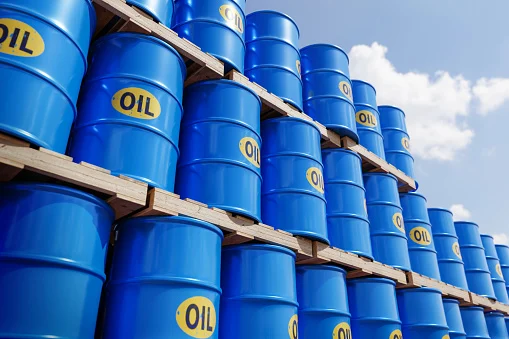

Crude Prices
Oil markets began the new week on a downward trajectory, with prices falling for the second consecutive day after President Donald Trump was inaugurated for his second term.
As of 11:40 am ET, Brent crude for March delivery had declined by 0.85%, trading at $79.49 per barrel, while West Texas Intermediate (WTI) crude for February delivery had dropped by 1.5%, falling to $76.68 per barrel.
Analysts attributed the recent price drops to the uncertainty surrounding President Trump’s upcoming policies and the market’s cautious outlook as his administration takes shape.
Tamas Varga, an oil analyst at PVM, suggested that the market’s downturn is a result of the unknowns surrounding Trump’s policy approach. “Given the performance of the market so far this year, it is reasonable to see some people take profit before the Trump administration’s modus operandi becomes clearer,” Varga explained to Reuters. This cautious sentiment among traders has contributed to the recent pullback in prices.
In contrast, a survey by Haynes Boone LLC revealed that banks anticipate oil prices could fall below $60 per barrel by mid-2025, a sentiment largely driven by Trump’s plans to push U.S. shale producers to ramp up production.
However, some analysts are optimistic about the outlook for oil markets. Experts from Standard Chartered have pointed to several factors that could keep oil prices strong in the near term.
These include the removal of Russian crude oil from the global market due to sanctions, which has already led to a significant reduction in Russian tanker shipments. According to Standard Chartered, new sanctions have effectively tripled the number of sanctioned Russian crude oil tankers, causing an estimated loss of around 900,000 barrels per day (bpd).
Although Russia may attempt to bypass sanctions through shadow fleets and ship-to-ship transfers, the bank predicts that around 500,000 bpd will be displaced over the next six months.
Beyond the sanctions, Standard Chartered also highlighted other contributing factors to market strength, including OPEC+’s adherence to production quotas, stronger-than-expected demand (which is not influenced by weather patterns), and lower-than-anticipated supply growth from non-OPEC countries.
These factors, along with the expected return of weather patterns to normal, suggest that the oil market will remain robust. Additionally, the delay by OPEC+ in increasing production quotas until April 2025, coupled with the extension of production cuts until the end of 2026, is expected to ensure that oil markets do not experience an oversupply in 2025, maintaining support for prices moving forward.
