

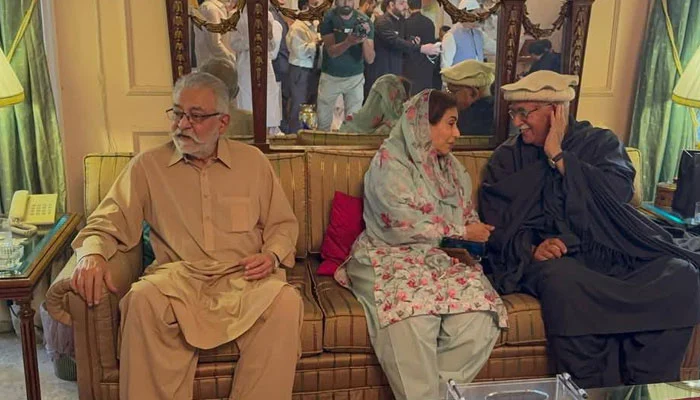

In a significant political development, opposition parties have agreed to collaborate for the supremacy of the Constitution and the independence of the judiciary and parliament. The agreement emerged during an initial formal interaction between the Tehreek-e-Tahafuz Ayeen-e-Pakistan (TTAP) and the Grand Democratic Alliance (GDA).
A TTAP delegation, led by Mahmood Khan Achakzai and including PTI’s Asad Qaiser, Salman Akram Raja, Sardar Lateef Khosa, Nasir Sheerazi, Haleem Adil Sheikh, Hamid Raza, and Sajid Tareen, met with GDA leadership, including Pir Sadaruddin Shah Rashdi, Dr Safdar Abbasi, Dr Fahmida Mirza, Liaquat Jatoi, Syed Zain Shah, Sardar Abdul Rahim, Dr Zulfiqar Mirza, and others. The meeting took place amid growing opposition efforts to strengthen their alliance and strategize against the government.
During the discussions, both sides agreed to form committees to work towards their shared objectives. The leaders highlighted concerns over issues affecting national interests, including constitutional amendments and new laws that they deemed restrictive.
Dr Fahmida Mirza strongly criticized the 26th Constitutional Amendment and amendments to the Prevention of Electronic Crimes Act (Peca), calling them oppressive. Meanwhile, Dr Safdar Abbasi stressed that both alliances were aligned in their stance against new canal constructions on the Indus River, citing threats to Sindh’s water rights.
Mahmood Khan Achakzai expressed admiration for Pir Pagara, acknowledging his family’s historical contributions to Pakistan’s independence. PTI’s Secretary-General Salman Akram Raja emphasized that the goal of the alliance was not power but collective efforts to uphold citizens’ rights.
Former National Assembly speaker Asad Qaiser confirmed that all opposition parties had been invited to a grand conference in Islamabad on February 26-27, where further strategies would be discussed. He also reaffirmed TTAP’s invitation for GDA to formally join the alliance in their pursuit of constitutional supremacy.
