

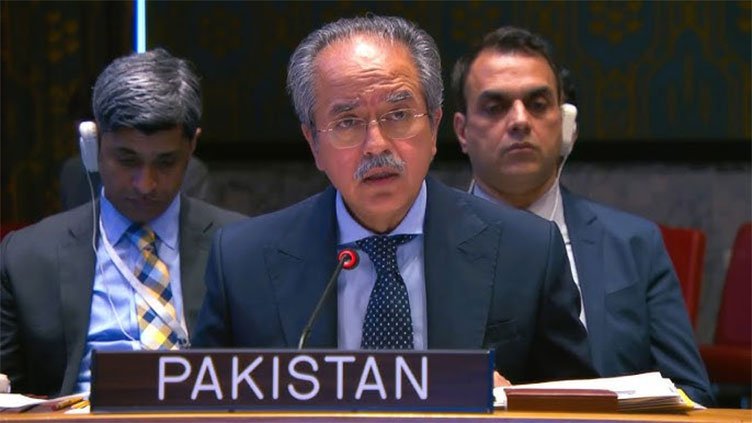

Pakistan has raised concerns before the United Nations Security Council (UNSC) regarding India’s rapid naval expansion, warning that such aggressive posturing threatens regional stability and aims to assert dominance over key maritime routes. The statement was made during a Security Council session focused on “Strengthening Maritime Security,” organized by Greece, which currently holds the rotating presidency.
Ambassador Asim Iftikhar Ahmad, Pakistan’s permanent representative to the UN, warned against unilateral actions in maritime regions that could undermine international legal norms and marginalize the rights of other coastal nations.
“We firmly reject attempts to dominate regional maritime zones or diminish the legitimate interests of neighboring coastal states under any justification,” he stated.
Ambassador Asim emphasized that oceans should foster cooperation and shared prosperity, not become battlegrounds for strategic power plays. Referring indirectly to India, he criticized the “alarming pattern of behavior” from a major regional actor seeking unchecked hegemony through aggressive naval buildup and the exclusion of neighbors from key regional maritime initiatives.
The envoy specifically mentioned India’s activities within the Indian Ocean Rim Association (IORA), alleging they reflect coercive diplomacy and undermine inclusive regional security efforts.
He also accused India of attempting to weaponize shared natural resources such as transboundary rivers, in violation of treaty obligations and the spirit of good neighborliness—moves he said were designed to destabilize cooperative frameworks and impose unilateral outcomes, particularly at Pakistan’s expense.
Ambassador Asim described the Arabian Sea as Pakistan’s “fifth neighbor,” highlighting its strategic importance to the country’s economic and regional connectivity ambitions. Pakistan’s unique geographic location, he noted, makes it well-positioned to function as a trans-shipment hub for trade with landlocked Central Asian nations.
Pakistan, he affirmed, has been a responsible contributor to international maritime security initiatives. The Pakistani Navy participates in the Combined Maritime Forces (CMF), conducting operations across the Arabian Sea, Gulf of Oman, and Red Sea to combat piracy, terrorism, and smuggling. Pakistan has also launched its own Regional Maritime Security Patrols (RMSP) to help ensure secure sea lanes.
Additionally, Pakistan engages in multilateral initiatives like the Djibouti Code of Conduct, while building national capabilities in port security, maritime awareness, marine conservation, and developing the blue economy.
Ambassador Asim also pointed to the urgent environmental threats facing marine and coastal ecosystems, including rising sea levels, ocean acidification, and shoreline erosion—stressing that these issues demand global cooperation.
He concluded by reaffirming Pakistan’s commitment to international law and multilateralism, calling for a collective rejection of efforts to use maritime space for strategic dominance.
“Pakistan is ready to work with all nations to uphold the integrity of the maritime domain and ensure our oceans remain peaceful, accessible, and beneficial for all,” he said.
