


Military Sites
On Thursday, Pakistan’s Deputy Prime Minister and Foreign Minister Ishaq Dar strongly accused India of orchestrating a deceptive narrative by targeting its own citizens, particularly from the Sikh community, in an effort to fuel anti-Pakistan sentiment under the guise of Hindutva ideology.
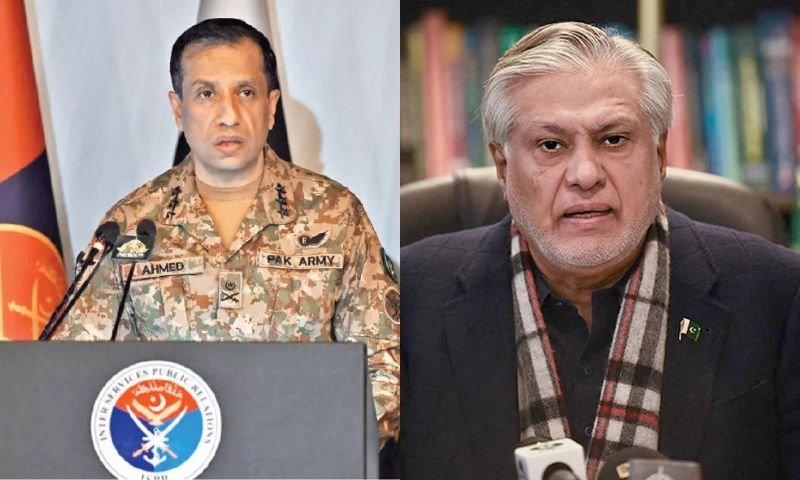
Speaking at a joint press conference alongside Director General Inter-Services Public Relations (ISPR) Lt Gen Ahmed Sharif Chaudhry, Dar condemned the Modi-led Indian government for what he termed as a reckless and dangerous strategy that puts the lives of Indian civilians at risk to create hostilities against Pakistan.
Dar emphasized that India was manipulating communal tensions by attempting to incite discord within its Sikh population, fabricating a narrative that positions Pakistan as the aggressor. “India’s Hindutva mindset wants to ignite tensions among Sikhs and create anti-Pakistan sentiment,” he stated. “By attacking its own population, India is trying to open a front against Pakistan.”
The joint press conference came amidst heightened tensions along the Pakistan-India border, including drone incursions, alleged missile strikes, and military engagements.
Dar revealed that Pakistani air defenses had intercepted multiple Indian drones, including one targeting Rawalpindi and another approaching the revered Sikh site of Nankana Sahib, both of which were successfully shot down. He asserted that these provocations demonstrated India’s disregard for civilian life and international norms.
Furthermore, Dar disclosed that India attempted to target the venue of the Pakistan Super League (PSL), underscoring the gravity of the situation. He rejected Indian claims of Pakistani missile strikes and accused India of launching coordinated attacks across over two dozen Pakistani cities, ranging from Islamabad to Karachi.
Dar assured the public that Pakistan’s armed forces had confronted and engaged 80 Indian aircraft during the ongoing hostilities, and reiterated that the military and all national institutions remain fully prepared and alert. He reaffirmed Pakistan’s right to respond to aggression at a time and place of its choosing, stating, “Pakistan reserves the right to respond, and we will do so decisively.”
In a further escalation of accusations, Dar condemned India’s unilateral suspension of the Indus Waters Treaty, calling it another hostile maneuver aimed at destabilizing bilateral ties. He called on India to provide verifiable evidence regarding the Pahalgam incident, challenging New Delhi to substantiate its claims. “Let India show the world proof of the alleged terrorism in Pahalgam. InshaAllah, victory will be Pakistan’s,” he concluded.
Lt Gen Ahmed Sharif Chaudhry, the DG ISPR, also addressed the press, underscoring that the drone targeting Nankana Sahib—home to one of Sikhism’s holiest shrines—was a red line that had been crossed. He confirmed that the drone was intercepted before causing damage. “A drone heading toward Nankana Sahib was also shot down,” he said, adding that India was now struggling to manage the fallout from its collapsing narrative on the global stage.
He mocked India’s contradictory behavior, stating, “India is conducting drills, while Pakistanis are playing sports,” a reference to the nation’s continued spirit and resilience amid military escalations. Lt Gen Chaudhry reiterated that Pakistan would not be intimidated and remains steadfast in defending its sovereignty and the safety of all religious communities.
