

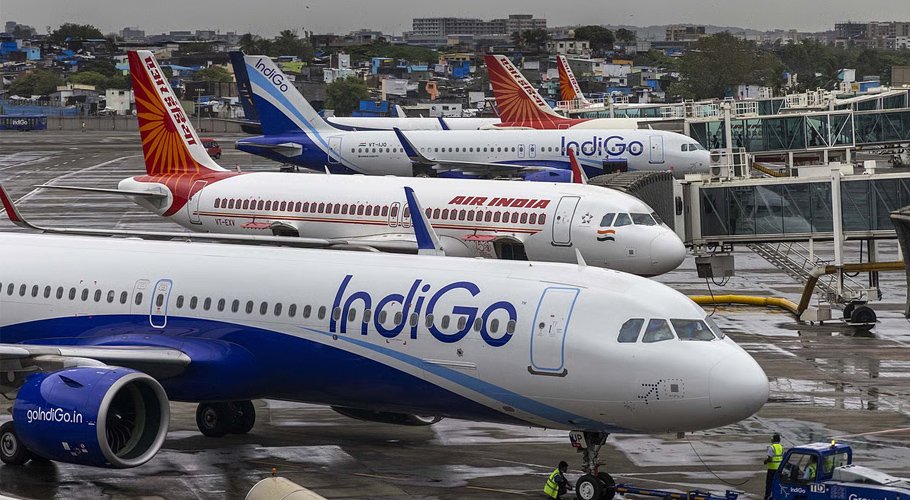

Pakistan has decided to prolong its airspace restrictions for Indian aircraft by another month, extending a measure that has already inflicted significant financial losses on Indian airlines.
According to sources, the extension is expected to be officially announced within the next 24 hours, after which a Notice to Airmen (NOTAM) will be issued. As per International Civil Aviation Organisation (ICAO) regulations, airspace closures cannot exceed one month at a time, requiring formal renewals for continued restrictions.
The initial decision to block Indian overflights followed a National Security Committee (NSC) meeting earlier this month. It came in response to Indian actions after the April attack in Pahalgam, which killed 26 tourists in Indian Illegally Occupied Jammu and Kashmir (IIOJK). The airspace closure applies to both military and commercial Indian flights.
Tensions escalated sharply after India closed its airspace to Pakistani flights on April 23. Pakistan responded the next day with a reciprocal ban. India then launched strikes on several Pakistani cities on May 6-7, to which Pakistan retaliated with “Operation Bunyan-um-Marsoos” on May 10, targeting Indian military installations. A ceasefire was later established following international diplomatic efforts and remains in effect.
Minimal Impact on Pakistani Aviation
Unlike its Indian counterpart, Pakistan’s aviation industry has experienced limited disruption due to the ban. Only a single eastbound route has been diverted via China, and flights to the Far East remain mostly unaffected.
Pakistan has previously implemented similar airspace restrictions during the 1999 Kargil conflict and the 2019 Pulwama incident, both of which had a heavier toll on India’s aviation sector.
Massive Losses for Indian Airlines
Indian airlines have incurred over Rs8 billion in losses in the past month. These losses include Rs5 billion in additional fuel consumption and another Rs3 billion in costs associated with stopovers for long-haul flights.
Aircraft such as Boeing 777s and Airbus A320 family jets are now spending an extra 2 to 4 hours in the air due to detours. With around 150 flights rerouted daily, fuel usage has surged. A Boeing 777 burns roughly 6,668 kg of fuel per hour, while A320 family aircraft consume about 2,400 kg per hour. At an average fuel price of $0.82 per kilogram, Indian airlines are spending close to $557,625 daily on extra fuel alone, amounting to over Rs5 billion for the month.
Extended flight durations have also triggered crew duty time limits, forcing crew changes at transit stops. These stopovers incur landing fees, refueling costs, and airport service charges, adding an estimated Rs2.5 to 3 billion in expenses over 30 days.
Air India has been hit hardest and has formally requested financial relief from the Indian government. Other carriers—including IndiGo, Air India Express, SpiceJet, and Akasa Air—have also experienced disruptions.
Flights originating from major Indian cities such as Amritsar, Delhi, Ahmedabad, Bangalore, and Jaipur are now forced to follow longer routes over the Arabian Sea, significantly impacting travel times and costs for flights to North America, Europe, and the Middle East.
Sources caution that if the ban is prolonged further and no government assistance is provided, Indian airlines may need to consider drastic measures to stay operational.
