


ILO Labour Standards
Pakistan has officially ratified three key International Labour Organisation (ILO) conventions aimed at strengthening workers’ rights, improving labour protections, and supporting evidence-based policy formulation to promote decent work, the ILO announced in a press release on Friday.
This significant step demonstrates Pakistan’s commitment to combating forced labour, aligning with international human rights standards, and advancing the United Nations Sustainable Development Goal (SDG) 8, which focuses on promoting decent work and economic growth.
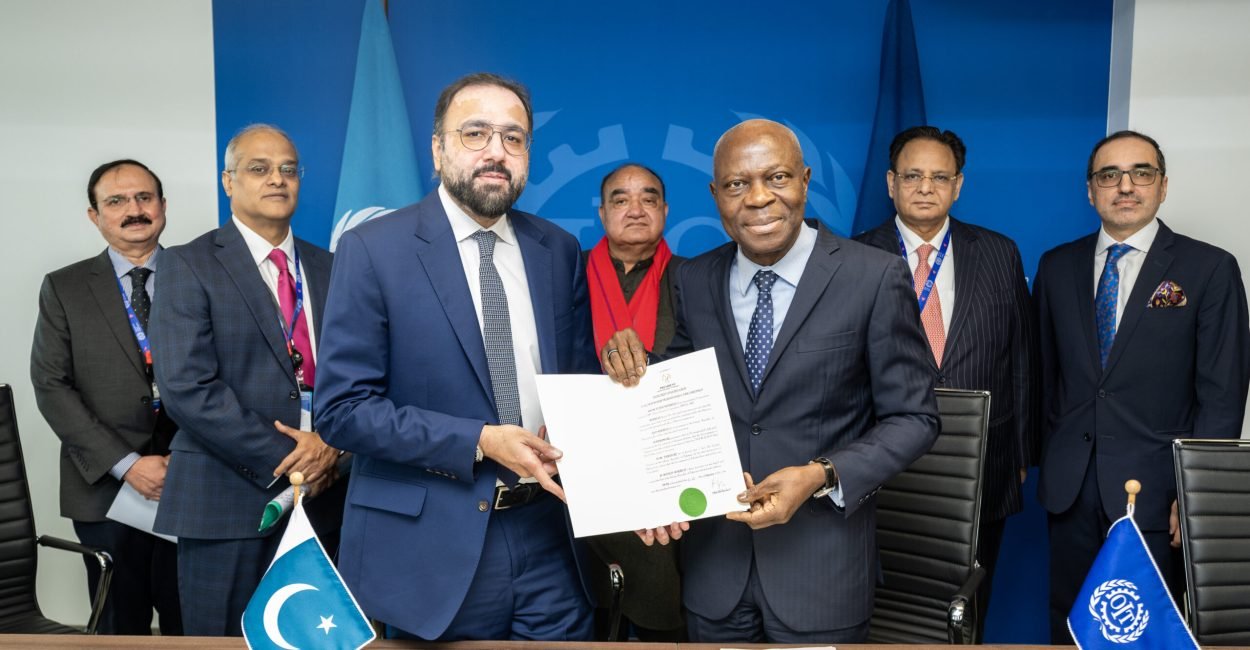
During the ILO Governing Body’s annual session in Geneva on Thursday, Pakistan’s Minister for Overseas Pakistanis and Human Resource Development, Chaudhry Salik Hussain, formally handed over the instruments of ratification to ILO Director-General Gilbert F. Houngbo.
The three conventions ratified by Pakistan include the ‘Protocol of 2014 to the Forced Labour Convention, 1930’, the amended ‘Maritime Labour Convention (MLC, 2006)’, and the ‘Labour Statistics Convention, 1985 (No. 160)’.
The ILO press release highlighted that the Protocol of 2014 supplements the original Forced Labour Convention, which Pakistan ratified in 1957. The protocol aims to strengthen the global fight against all forms of forced labour, including human trafficking and slavery-like practices.
The ratification of the Maritime Labour Convention (MLC, 2006) is seen as a major step forward in ensuring Pakistan complies with international maritime standards.
This convention protects the rights of seafarers, guaranteeing fair and safe working conditions, including minimum age requirements, employment agreements, working hours, wages, paid leave, and access to onshore and offshore medical care. It also ensures protection for national seafarers and foreign workers entering Pakistani ports while promoting a level playing field for shipowners.
In addition, by ratifying the Labour Statistics Convention, 1985 (No. 160), Pakistan has committed to enhancing the capabilities of its national statistical offices, particularly in collecting and analyzing labour market data.
This move aims to strengthen the country’s labour information infrastructure, enabling more effective, evidence-based policymaking. The improved data will support efforts to create decent jobs, reduce inequalities, and provide safer and more inclusive workplaces, especially for vulnerable groups.
Speaking on the occasion, Minister Salik Hussain emphasized Pakistan’s dedication to eradicating forced labour, safeguarding the rights of seafarers, and improving the quality of labour market data.
He noted that the decision to ratify these conventions was made after thorough consultations with tripartite constituents, including representatives from the government, employers, and workers.
“This decision reflects Pakistan’s strong commitment to protecting labour rights and establishing a fair and equitable working environment,” Hussain said.
Geir Tonstol, Director of the ILO’s Country Office for Pakistan, hailed the ratifications as “historic.” He pointed out that this marks Pakistan’s first ratification of an international labour standard since the country adopted the Minimum Age Convention in July 2006.
“It exemplifies Pakistan’s renewed dedication to global labour standards and the protection of workers’ rights. The ILO stands ready to support Pakistan in turning these commitments into concrete actions that will benefit both workers and employers,” Tonstol stated.
The ratification of these three conventions is expected to enhance Pakistan’s global standing in labour rights protection, improve working conditions, and boost the country’s efforts in combating forced labour and human trafficking.
Moreover, it will strengthen Pakistan’s labour data infrastructure, enabling the development of more effective policies to promote decent work and social justice.
