

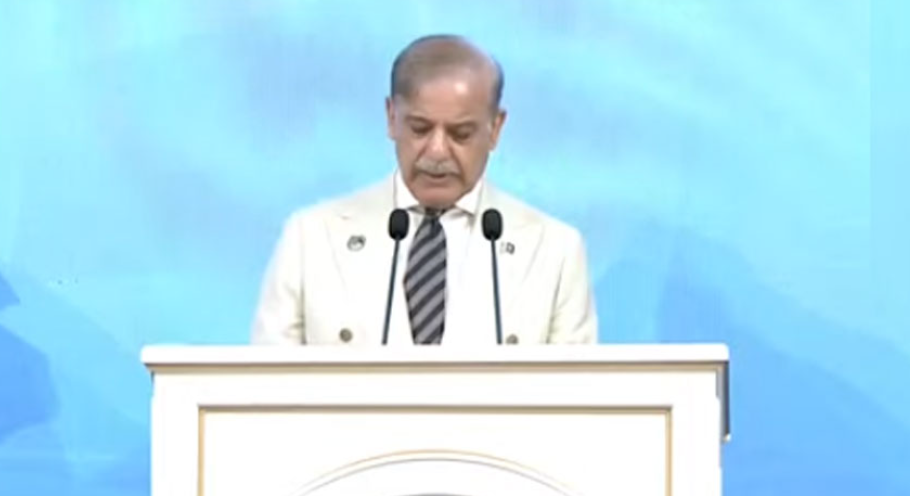

Prime Minister Shehbaz Sharif, speaking at the High-Level International Conference on Glaciers’ Preservation in Dushanbe, Tajikistan, firmly rejected the politicization of water and warned that Pakistan would not tolerate India’s unilateral suspension of the Indus Water Treaty (IWT). He stressed that millions of lives must not be endangered for political motives and asserted that Pakistan would never allow its “red line” to be crossed.
Sharif condemned India’s decision to hold the treaty in abeyance, calling it illegal and deeply regrettable. He emphasized that such actions undermine regional cooperation and pose serious risks to the shared resources that sustain life across borders.
The Prime Minister delivered his address before an audience of over 2,500 participants from 80 United Nations member states and 70 international organizations, including global leaders, ministers, and UN officials. The three-day event, organized by the Government of Tajikistan in partnership with the United Nations, UNESCO, the World Meteorological Organization, the Asian Development Bank, and other stakeholders, marks a significant step toward global glacier preservation and climate resilience.
Declaring that water must be treated as a symbol of unity rather than conflict, Sharif urged the international community to act collectively against the weaponization of shared resources.
Highlighting Pakistan’s climate vulnerability, he reminded attendees that the country is home to over 13,000 glaciers, which feed nearly half of the Indus River system’s annual flow. He underscored the importance of the five major rivers—Indus, Jhelum, Chenab, Ravi, and Sutlej—whose stability relies on these glacial systems, placing Pakistan among the most climate-vulnerable nations globally.
Sharif referenced the devastating floods of 2022 as a tragic consequence of accelerated glacial melt. Despite contributing less than 0.5% to global emissions, Pakistan remains one of the top 10 countries most at risk from climate change. He called for a swift and comprehensive global response to prevent similar disasters in the future.
Scientific projections, he warned, indicate an alarming trend of intensified flooding due to glacial retreat, followed by severe declines in river flows, which could devastate ecosystems and livelihoods. These warnings, he said, must not be ignored.
The Prime Minister urged developed nations to fulfill their climate finance pledges, calling for balanced investment in mitigation, adaptation, and recovery from climate-induced losses and damages. He also highlighted the need for enhanced early warning systems and disaster preparedness.
Reflecting on his personal connection to rivers like the Ravi and Tajikistan’s Vakhsh, Sharif spoke of the shared ecological heritage that binds nations and called for collective efforts to safeguard these vital natural resources.
He concluded with a call to action: “Let us protect and preserve nature’s precious gifts for the sake of our planet and future generations.”
