

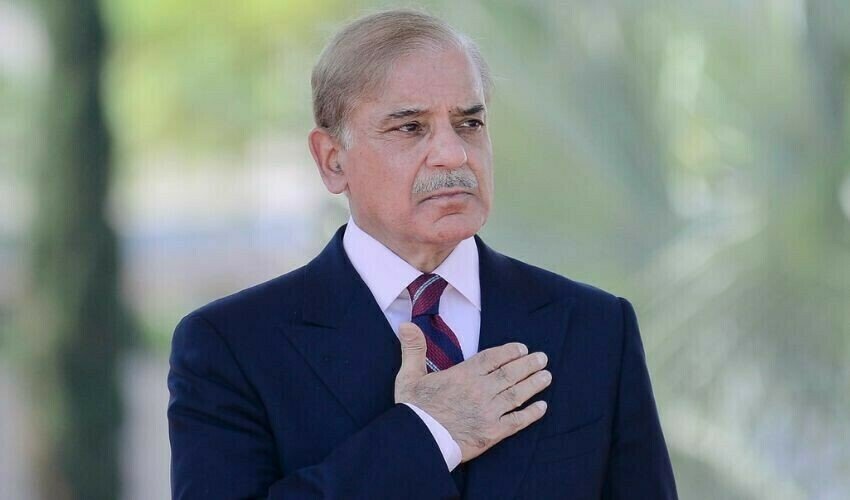

Prime Minister Shehbaz Sharif announced on Wednesday that concerns over the International Monetary Fund (IMF) opposing a reduction in electricity prices have been resolved.
For years, inflation-burdened consumers in Pakistan have struggled with soaring power tariffs, leading to widespread economic distress, industrial slowdowns, and social unrest in the $350 billion economy, which has contracted twice amid record inflation.
“The IMF’s chief has assured that Pakistan’s proposal for lowering electricity prices will be duly considered,” Shehbaz stated while briefing the federal cabinet on his recent visit to Dubai.
On Tuesday, the premier met IMF Managing Director Kristalina Georgieva on the sidelines of the World Government Summit (WGS) 2025 in Dubai, ahead of the first review of Pakistan’s $7 billion bailout scheduled for early March.
Chief of Army Staff (COAS) General Syed Asim Munir accompanied Shehbaz on the visit, where they engaged in discussions with UAE President Sheikh Mohammed bin Zayed Al Nahyan regarding bilateral relations and investment opportunities.
Shehbaz shared that during his meeting with the IMF chief, he emphasized Pakistan’s economic challenges, particularly in the power sector. “I explained that industrial growth depends on reducing production costs,” he said, adding that Georgieva responded positively.
“The IMF’s resistance to lowering electricity tariffs is no longer an issue,” the premier assured, revealing that the lender has invited Pakistan to present its detailed plan.
He also praised his economic team for successfully negotiating the bailout and implementing reforms, noting that the IMF had acknowledged their efforts. The cabinet applauded the team’s work in securing the critical funding.
Regarding Pakistan’s ties with Saudi Arabia, Shehbaz reaffirmed unwavering support for Riyadh’s sovereignty, security, and territorial integrity.
Highlighting economic progress, he noted a sharp rise in overseas remittances, which surged to $20.8 billion in the first seven months of FY25 from $15.8 billion a year earlier—a 31.7% increase—reflecting growing confidence among expatriates.
Addressing the recent migrant boat tragedy in Libya, the premier urged strict action against human trafficking, calling for an end to the “dark trade.”
A statement from the Prime Minister’s Office (PMO) emphasized that Pakistan’s economy is on a path to long-term stability, backed by the IMF’s support.
Following the Dubai meeting, Georgieva posted on X, expressing encouragement over Pakistan’s commitment to reforms, stating that decisive action would drive economic growth and job creation.
As Pakistan approaches the IMF review, the government and central bank remain confident about meeting reform targets, despite ongoing economic recovery challenges.
The discussions also focused on maintaining macroeconomic stability through fiscal discipline and continuing reforms in taxation, energy efficiency, and private sector development.
Meanwhile, a three-member IMF mission is in Pakistan for an assessment under the Extended Fund Facility (EFF) program.
