

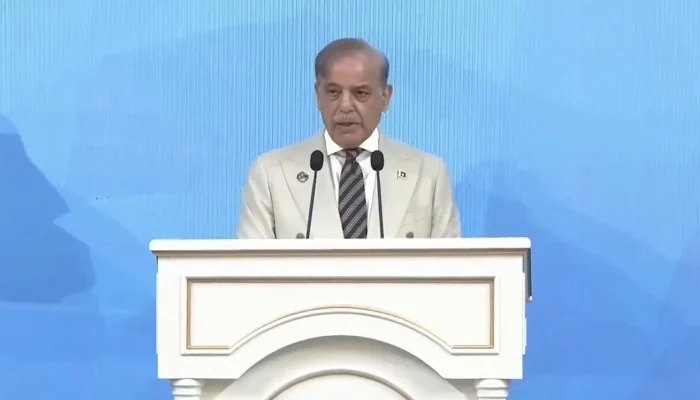

Prime Minister Shehbaz Sharif has called for urgent and united global action to tackle the growing threat of climate change, emphasizing the critical need for international cooperation to safeguard the planet’s most vulnerable ecosystems.
Speaking at the International Conference on Glaciers Preservation 2025 held in Dushanbe, Tajikistan, the Prime Minister stressed that developed nations must honor their climate finance commitments to help bridge funding gaps and support the development of climate-resilient infrastructure in vulnerable countries.
He highlighted the importance of investment in early warning systems, disaster preparedness, and robust management strategies to reduce the risks posed by climate-related disasters.
Sharif underlined the essential role of glacier preservation, especially for countries like Pakistan, which hosts one of the world’s largest glaciated areas outside the Polar Regions. He noted that nearly 50% of the annual water flow in the Indus River system—which sustains Pakistan’s economy, culture, and civilization—is glacier-fed.
He pointed out the vulnerability of Pakistan’s five key rivers—Indus, Jhelum, Chenab, Ravi, and Sutlej—to glacial changes, warning that shifts in the glacial system could have devastating impacts on the region.
Recalling the catastrophic floods of 2022, he said the event served as a stark example of the accelerating pace of glacier melt due to climate change.
Sharif emphasized that no country has more at stake in glacier protection than Pakistan and called for increased international cooperation to ensure sustainable water resources.
He also spoke about the shared nature of transboundary water systems, urging nations to treat water as a unifying resource rather than a tool of conflict. In this context, he condemned India’s unilateral suspension of the Indus Waters Treaty, describing it as a deeply regrettable act that undermines regional stability.
The Prime Minister warned against the politicization of vital water resources and affirmed that Pakistan will not tolerate any violation of its water rights, stating clearly that the country’s “red line” must not be crossed.
