

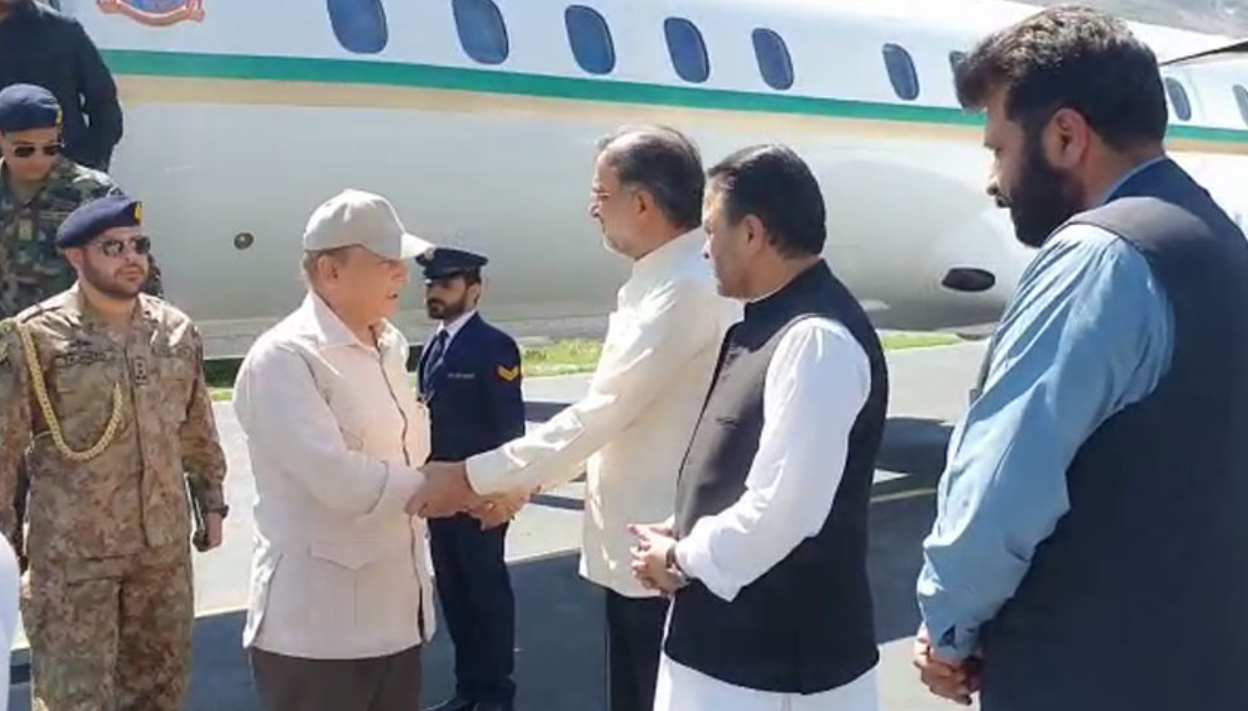

Prime Minister Shehbaz Sharif arrived in Gilgit-Baltistan (GB) on Monday for a day-long visit to assess the widespread destruction caused by recent monsoon-triggered floods and to distribute relief funds among the affected communities.
The floods, which struck GB on July 21, triggered massive landslides, damaged vital infrastructure, and left over 500 homes destroyed or severely impacted. Many roads and public facilities remain inaccessible. So far, the natural disaster has claimed at least 10 lives, most of them tourists, while 10 to 15 others are still reported missing.
Upon arrival at Gilgit Airport, the prime minister was received by Governor Syed Mehdi Shah, Chief Minister Gulbar Khan, and other high-level officials. He was accompanied by key federal ministers, including those responsible for climate change, communications, information, and Kashmir affairs, as well as political aides and coordinators linked to GB affairs.
During his visit, Prime Minister Shehbaz is expected to meet flood victims directly, listen to their concerns, and oversee the disbursement of relief funds. He will also be briefed by local authorities on the scale of damage inflicted by the recent rains and resulting floods.
In a statement issued on the occasion, GB government spokesperson Faizullah Faraq emphasized the significance of the prime minister’s visit. “The hopes of the flood-affected communities are pinned on the premier,” he said. Faraq noted that the region had suffered damages exceeding Rs20 billion due to the catastrophic flooding.
Earlier, Chief Minister Gulbar had made an urgent appeal to the federal government for Rs7 billion in emergency funding to address the growing impact of climate-related disasters in the region. Officials have described federal assistance as crucial, likening it to “oxygen” for GB, particularly for those who have lost their homes and livelihoods.
The visit comes at a critical time as the effects of climate change become increasingly visible across Gilgit-Baltistan. Rising temperatures, erratic weather conditions, and glacial melting have led to a surge in cloudbursts, flash floods, and landslides. These phenomena are now a recurring threat to life and infrastructure in the mountainous region.
In the latest incidents, five members of a family trapped in floodwaters in the Ghizer district were successfully rescued. Meanwhile, separate flash floods triggered by cloudbursts have recently impacted areas in both Ghizer and Hunza.
A tragic incident was also reported in GB’s Bagrot Valley, where a glacier burst led to the death of a 12-year-old boy and injured his father. In another event, a rescue attempt in the Ghizer River left three people missing after they tried to save a man who had jumped into the water.
The prime minister’s visit has been welcomed as a sign of commitment from the federal government to support GB in its recovery efforts. Local officials and residents alike are hopeful that the trip will expedite the allocation of funds and mobilization of resources necessary for rehabilitation and reconstruction.
