

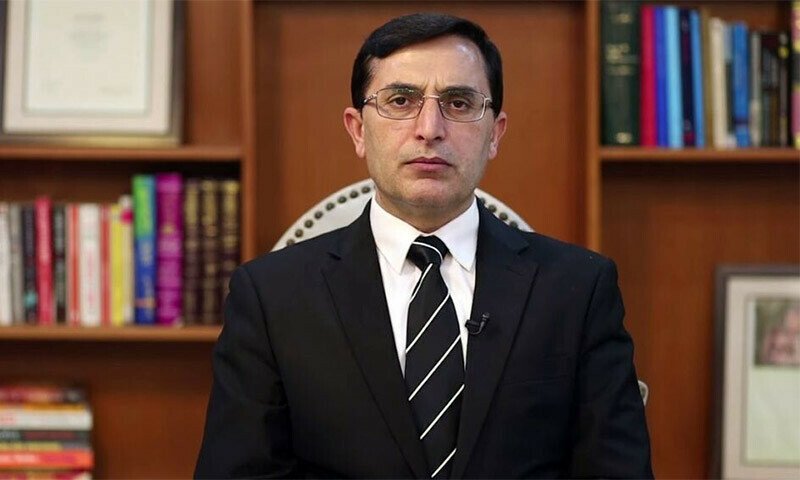

Pakistan Tehreek-e-Insaf (PTI) Chairman Gohar Ali Khan has extended congratulations to Chief of Army Staff General Asim Munir on his promotion to the rank of field marshal, noting that the new designation carries greater responsibility to help stabilize the country’s situation.
The government’s decision to elevate Gen Munir to field marshal status came earlier this week in recognition of what was described as his strategic leadership and decisive role during the recent military standoff with India, which ended following a ceasefire brokered by the United States.
Field marshal is the highest military rank in armies modeled on the British system and has only been conferred once before in Pakistan—to General Mohammad Ayub Khan in 1959.
Speaking to the media outside Rawalpindi’s Adiala Jail after meeting with imprisoned former Prime Minister Imran Khan, Gohar said, “A long time has passed. PTI is a major political force, and Khan Sahib remains the most popular leader. We want these challenges to come to an end.”
He continued, “The army chief has received the rare distinction of field marshal. While we have congratulated him, this new honour also brings added responsibility to play a stronger role in improving the national climate.”
Gohar clarified that PTI will soon issue an official party stance on the development. He also stated, “We have no enmity with the military. Khan Sahib said yesterday as well that we stand with the armed forces and believe that anyone associated with them should remain above controversy.”
He added that while communication with the military establishment has yet to be restored, PTI is open to dialogue. “Khan Sahib has always said the door to talks was never shut,” he remarked.
Gohar’s comments aligned with a message shared earlier from Imran Khan’s account on X (formerly Twitter), where the former premier expressed willingness to engage with those holding power for the sake of the country.
When asked about the military’s political role, Gohar responded, “We all agree the military should stay out of politics, and I believe any effort to resolve issues should rise above political interests. It’s a powerful institution and can influence outcomes—so I appeal to those who can help, to do so.”
The promotion of Gen Munir was first cleared by the federal cabinet and later officially communicated by Prime Minister Shehbaz Sharif to President Asif Ali Zardari. It marks the first elevation to field marshal rank in over 60 years.
In a separate move, the government also granted Air Chief Marshal Zaheer Ahmed Babar Sidhu a second extension, making him the first Pakistan Air Force chief to receive two consecutive extensions in service.
Commenting on India, Gohar remarked that “the atmosphere of conflict still persists,” and praised Pakistan’s military for achieving what he termed a “remarkable victory that India could never have foreseen.” He emphasized that the recent conflict was even more serious than the wars of 1965 and 1971, due to both countries being nuclear-armed.
He warned the public to remain vigilant against any further aggressive moves or hostile intentions from India.
Regarding the military hierarchy, the Ministry of Defence stated that Gen Munir’s promotion was made under Rule 199A of the Army Regulations (Rules) 1998. Though the rulebook is classified, military sources indicate that it allows the federal government to elevate any general officer—active or retired—to field marshal, without regard to seniority or position.
Legal experts, however, point out that the Constitution and the Pakistan Army Act are silent on the specifics of such appointments.
While the rank of field marshal does not grant expanded operational control, the promotion carries significant symbolic value, particularly during a period of internal instability and civil-military tension. It is expected to enhance Gen Munir’s influence within the military and political establishment.
Senator Mushahid Hussain Syed, a former head of the Senate Defence Committee, noted that Gen Munir now stands at the center of Pakistan’s power structure, especially given the fragmented state of civilian political forces. He observed, “Before May—an inflection point for Pakistan, India, and South Asia—all major political actors accepted that the road to Islamabad runs through Rawalpindi.”
The appointment follows a global pattern, where such ranks are largely ceremonial. In India, Field Marshals Sam Manekshaw (1973) and K.M. Cariappa (1986) were honored for distinguished service without changes to command structures. The same precedent is seen in the UK and US, where five-star ranks have historically recognized exceptional wartime contributions.
