

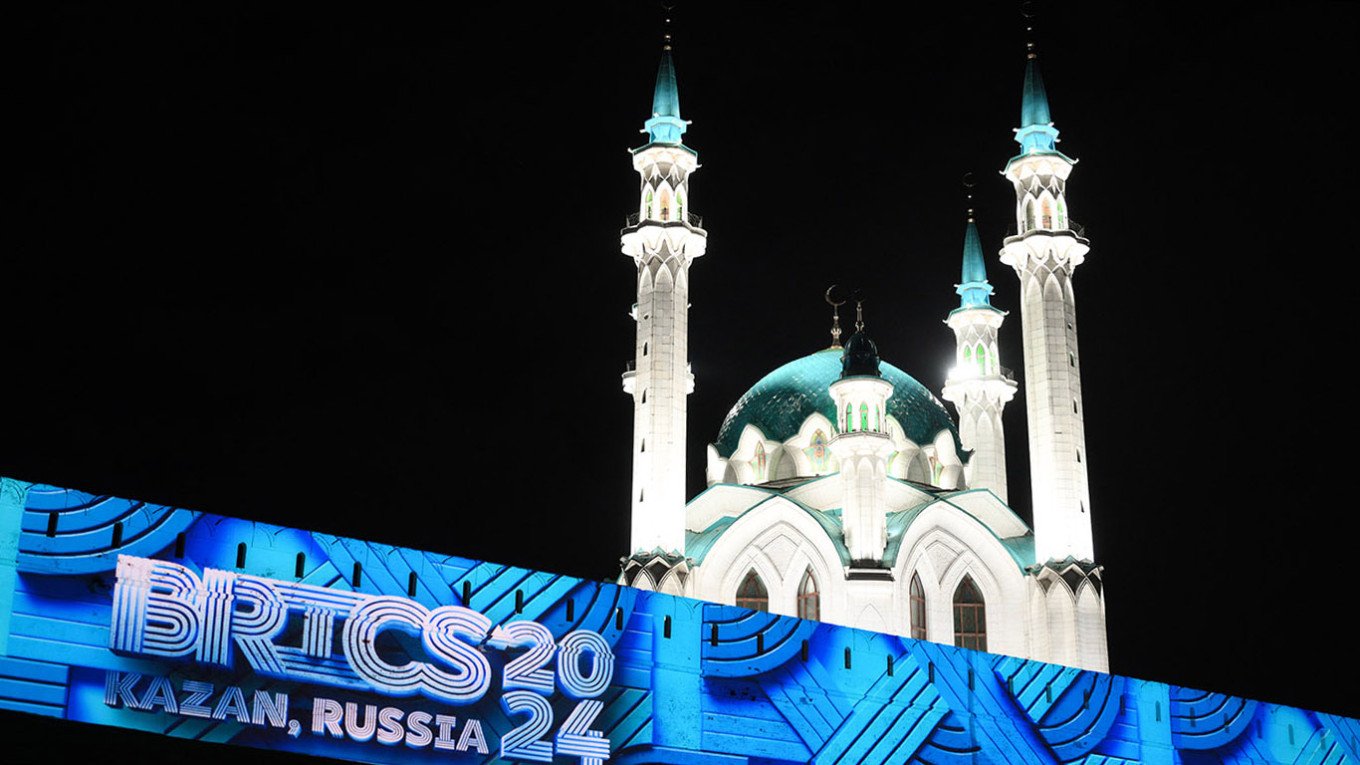

When the annual BRICS economic bloc summit kicks off on Tuesday in Kazan, the capital of Russia’s Tatarstan Republic, Moscow will spare no effort in showcasing the alliance as a growing geopolitical counterbalance to the West.
Yuri Ushakov, an aide to President Vladimir Putin, has already called it “the largest foreign policy event ever held” in Russia while independent analysts emphasize its potential to reshape the global order.
The BRICS bloc, founded in 2009 by Brazil, Russia, India, and China, expanded in 2010 with South Africa’s inclusion. Last year, the group grew into BRICS+ with Egypt, Ethiopia, Iran, and the United Arab Emirates joining as permanent members. While Saudi Arabia and Argentina were invited to join in the first major expansion, they have yet to formalize their membership.
Despite hesitation from some major players, BRICS+ in its current form represents over 37% of global GDP—more than double that of the European Union—and accounts for more than 41% of the world’s population.
Although Saudi Crown Prince Mohammed bin Salman won’t attend the three-day summit in Kazan, there will be a strong lineup of high-profile attendees. According to Ushakov, 24 heads of state were expected as of last week.
Along with the leaders of BRICS+ nations, UN Secretary-General Antonio Guterres and Turkish President Recep Tayyip Erdogan—the sole leader from a NATO country—are also expected to attend.
Turkey formally applied for BRICS membership last month, according to insider reports cited by Bloomberg. For Ankara, joining BRICS aligns with the shift in the geopolitical center of gravity toward the Global South, while also fitting into Turkey’s balancing act between the West and Russia.
“Membership could not only boost trade opportunities but also compel Ankara’s Western allies to pay more attention to its domestic concerns. At the very least, Turkey hopes it will soften their cold-shouldering of the Turkish capital,” wrote Aslı Aydıntaşbaş, a fellow at the European Council on Foreign Relations.
Several of Russia’s post-Soviet allies, including Azerbaijan and Belarus, have also applied for BRICS membership. However, Kazakhstan, Central Asia’s largest economy, has decided to “abstain” from joining, according to a statement from President Kassym-Jomart Tokayev’s spokesperson last week—a decision the Kremlin has vowed to “respect.”
