

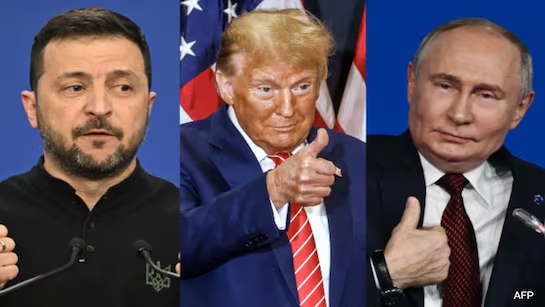

Russian officials see President Donald Trump’s urgency to end the war in Ukraine as an opportunity to negotiate the most favorable outcome for Moscow.
In a dramatic shift three years after Russia’s full-scale invasion of Ukraine froze diplomatic relations with Washington, senior U.S. and Russian officials engaged in marathon talks in Saudi Arabia on Tuesday.
Beyond Ukraine, discussions reportedly included the possibility of a summit between Trump and President Vladimir Putin, as well as broader improvements in U.S.-Russia relations—an avenue Moscow is eager to explore.
Moscow’s Strategy for Negotiations
Putin has instructed his envoys to adopt a “friendly and, in some cases, even complimentary” stance toward their American counterparts—particularly Trump himself—to maximize gains from any forthcoming agreements, a Russian diplomatic source revealed.
“Our delegation was tasked with negotiating, not arguing,” one diplomat said, emphasizing a calculated balance between flexibility and toughness in Moscow’s approach.
Sources suggested that the team of Russian negotiators extends beyond those present at Tuesday’s Riyadh meeting. Key figures expected to participate in further discussions include:
- Sergei Naryshkin, Foreign Intelligence Service chief (focused on intelligence sharing and counterterrorism)
- Sergei Ryabkov, Deputy Foreign Minister (arms control and strategic stability)
- Mikhail Bogdanov, Putin’s Middle East envoy
However, billionaire Roman Abramovich, who played a role in 2022 peace talks, is unlikely to be involved this time, as the Kremlin has lost interest in engaging with Ukrainian President Volodymyr Zelensky, according to officials.
Kremlin’s Expectations from Trump
Russian officials believe Trump is eager to secure a swift and high-profile foreign policy victory—potentially one that, in their words, “is not always carefully thought through.”
They anticipate that Trump may seek a symbolic moment where he can claim personal credit for ending the Ukraine war, and they see this as a chance to extract long-desired concessions.
At the same time, Moscow acknowledges that the U.S. stance could shift as negotiations advance and working groups are established in the wake of the Riyadh meeting.
