


Anti-Army Narrative
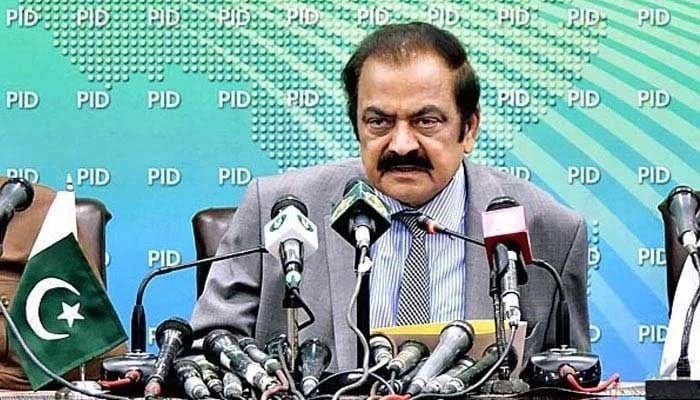
Adviser to the Prime Minister on Political and Public Affairs, Rana Sanaullah Khan, on Thursday, strongly criticized former Prime Minister Imran Khan, claiming that his letters to Chief of the Army Staff (COAS) General Asim Munir were merely an attempt to spread anti-army propaganda.
Sanaullah’s remarks came after the army chief denied having received any letter from the incarcerated Pakistan Tehreek-e-Insaf (PTI) founder. In an informal interaction with journalists earlier in the day, General Munir, while seemingly referring to Imran Khan’s open letters, stated that even if he were to receive such a letter, he would not read it.
Following the COAS’s statement, Sanaullah lauded his response, calling it “brief and comprehensive.” Speaking during a television interview, the Pakistan Muslim League-Nawaz (PML-N) leader alleged that Khan’s letters were part of a larger strategy to create a negative narrative against the Pakistan Army. “Everyone understands the tricks of the PTI founder,” he remarked.
He further stated that Imran Khan’s letters were first released to the media before being formally communicated, suggesting that their primary purpose was not genuine dialogue but propaganda.
According to him, had these letters not been publicized, they might have received a response. He pointed out that Khan had also written a letter to Chief Justice of Pakistan (CJP) Yahya Afridi, but that communication was not made public in the same manner.
Sanaullah also dismissed any speculation that PTI was genuinely seeking backdoor negotiations. He asserted that the party had no intention of apologizing for its alleged anti-military stance or the May 9 incidents and was instead attempting to manipulate public perception.
PTI’s parliamentary leader, Senator Ali Zafar, however, defended the move, stating that open letters are a common practice worldwide.
He maintained that Imran Khan, as a former prime minister, had the right to highlight what he perceived as faults in the system. When asked why Khan had not written to the Prime Minister instead, Zafar responded that addressing national issues was the responsibility of parliament.
Imran Khan, who has been imprisoned since August 2023 and faces multiple charges ranging from corruption to terrorism, has reportedly written three open letters to the COAS.
His legal representative, Faisal Chaudhry, revealed that in his most recent letter, Khan reiterated allegations of election rigging, claiming that “money launderers” had been installed in power through manipulated polls.
According to his lawyer, the PTI founder expressed concerns in his letters about what he saw as the military’s growing disconnect from the public. Khan outlined six key points, urging the army to reconsider its policies and offering suggestions to bridge the divide.
These letters came after PTI ended its negotiations with the PML-N-led government last month. The party had initially sought two key demands: the formation of judicial commissions to investigate the events of May 9, 2023, and November 24-27, as well as the release of all political prisoners, including Imran Khan himself.
In December 2024, the Director General of Inter-Services Public Relations (ISPR), Lieutenant General Ahmed Sharif Chaudhry, had dismissed the idea that any political leader’s ambitions should take precedence over Pakistan’s interests.
His statement, issued in response to reports of backdoor talks between PTI and the establishment, emphasized that no individual’s pursuit of power was above the country’s well-being.
While PTI insists that Imran Khan’s letters are an effort to engage in constructive dialogue, the government maintains that they are part of a broader strategy to fuel anti-military sentiment. As political tensions continue to escalate, the letters have become another flashpoint in the ongoing struggle between PTI and the ruling coalition.
