

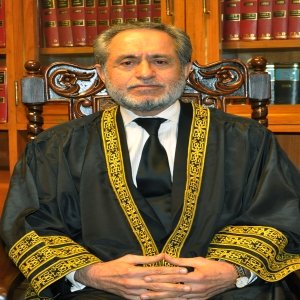

Supreme Court Justice Jamal Khan Mandokhail on Wednesday questioned whether a military personnel committing an offence at home would fall under the jurisdiction of the Army Act.
His remarks came during a hearing of intra-court appeals challenging the military trials of civilians. The seven-member constitutional bench, headed by Justice Aminuddin Khan, heard arguments from Salman Akram Raja, counsel for convict Arzam Junaid.
Raja argued that the case revolved around two key issues, one concerning Article 175 of the Constitution. He emphasized that fundamental rights must not be compromised under any legal framework.
Justice Mandokhail questioned whether integrating fundamental rights with a specific law could lead to their violation. He also asked if a soldier marrying a second time without the first wife’s consent would be subject to a military trial.
In response, Raja described the Army Act as a “black hole,” arguing that any amendments could threaten fundamental rights. He maintained that for an offence to be tried under the Army Act, it must have a direct connection to military service.
Giving an example, Raja noted that while kite-flying is banned in Punjab, a military officer engaging in the act at home would be prosecuted under civilian law, not by a military court.
Justice Naeem Akhtar Afghan pointed out that during Pakistan Tehreek-e-Insaf’s (PTI) tenure, there had been active legislation concerning the Army Act. Raja, however, distanced himself from the matter, stating that he was in opposition at the time and not part of PTI.
Raja also cited the 1975 FB Ali case, where Section 2(1)(d) of the Army Act was first debated.
Justice Muhammad Mazhar Ali questioned why the Supreme Court repeatedly reviewed Article 2(1)(d), to which Raja responded that evolving legal frameworks necessitate judicial review. He asserted that Article 8(3) does not create an exception for Article 2(1)(d).
Justice Afghan asked whether an ordinance introduced in 1967 for Article 2(1)(d) had expired and, if so, whether it remained valid. Raja countered by referencing the Official Secrets Act, in place since 1923, which allows for trials under its provisions even before 1967.
Justice Mandokhail highlighted a distinction between civil and military service, noting that while civil servants found guilty of misconduct are dismissed, military personnel can face both dismissal and legal penalties. He sought further clarity on the Army Act’s scope.
Justice Mazhar inquired where a spy should be tried, while Justice Hassan Azhar Rizvi questioned where a citizen leaking state secrets to an enemy should be prosecuted.
Raja replied that such offences fall under the Official Secrets Act, which provides a legal framework for prosecution.
He assured the court that his arguments remained constitutionally sound, stating that fundamental rights cannot be arbitrarily revoked.
“It cannot be that a commanding officer simply demands a suspect and they are handed over,” he asserted.
Justice Mazhar noted that a five-member bench had already struck down Section 2(d), ruling that espionage suspects could no longer be tried in military courts. However, he clarified that civilian employees working within the army still fell under the Army Act’s jurisdiction.
After hearing the arguments, the seven-member bench adjourned proceedings until Thursday.
