

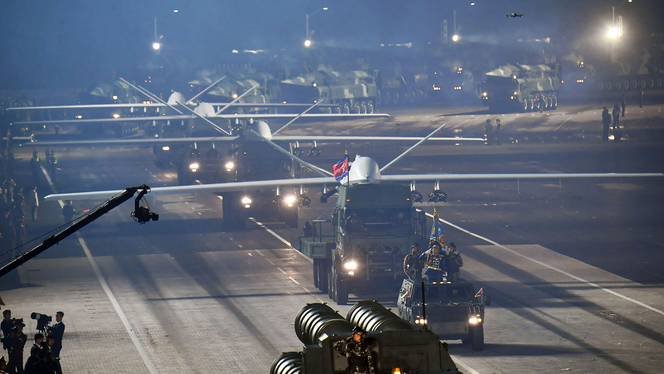

SEOUL: South Korea will begin deploying drone-melting laser weapons designed to shoot down North Korean UAVs this year, according to the country’s arms procurement agency.
The new laser weapons, dubbed the “StarWars Project” by the South, are invisible, noise-free, require no additional ammunition, and operate solely on electricity at a cost of approximately $1.45 per shot, as stated by the Defense Acquisition Program Administration (DAPA).
The “Block-I” system, developed by Hanwha Aerospace, will be “put into operational deployment in the military this year,” said Lee Sang-yo, a DAPA official.
The two Koreas remain technically at war since the 1950-53 conflict ended in an armistice, not a peace treaty.
In December 2022, Seoul reported that five North Korean drones crossed into the South, marking the first such incident in five years. Despite firing warning shots and deploying fighter jets, the South Korean military failed to shoot any of them down.
The South’s “ability to respond to North Korea’s drone provocations will be significantly enhanced” by the laser weapons system, DAPA said in a statement on Thursday. The system has successfully achieved a 100 percent shoot-down rate in previous tests and, with future improvements, could become a “game-changing” weapon capable of countering aircraft and ballistic missiles, according to DAPA.
The “StarWars” system, described as a “weapon of the future” by official Lee, neutralizes targets by directly hitting them with laser light generated from optical fiber.
“When a laser weapon transfers heat to a drone, its surface melts. As the surface melts, the internal components catch fire, causing the drone to eventually fall,” Lee explained.
“This laser weapon uses electricity, so simply increasing the output allows it to travel at the speed of light,” he added. “Laser weapons can travel even further in space where there is no air,” giving them a significant advantage over conventional weapons.
However, some analysts remain cautious about the weapon’s capabilities. “Laser weapons have not yet been put to practical use worldwide, and further verification and more time are needed to determine whether they can be utilized as a practical weapon system,” said Hong Sung-pyo, senior researcher at the Korea Institute for Military Affairs.
“Laser weapons also have an operational range. While it may be possible to shoot down North Korean drones that come within this range, it is difficult to target those that are outside of it,” he added.
