

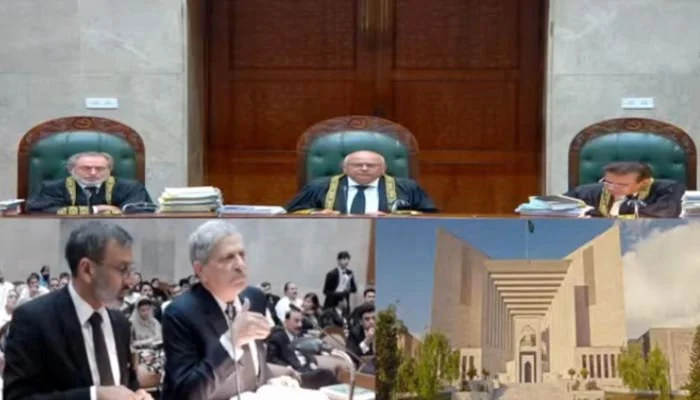

In a major legal blow to the Imran Khan-founded Pakistan Tehreek-e-Insaf (PTI), the Supreme Court of Pakistan has ruled that the party is not entitled to reserved seats for women and minorities in both the national and provincial assemblies.
The landmark decision was delivered on Friday by a 10-member constitutional bench headed by Justice Aminuddin Khan, who announced the short order, stating that the review petitions were accepted by a 7-5 majority. The judgment nullifies the Supreme Court’s previous July 12, 2024, ruling and reinstates the verdict of the Peshawar High Court (PHC).
The ruling effectively dismisses civil appeals filed by the Sunni Ittehad Council (SIC), to which PTI-backed independent candidates had joined post-election, in an attempt to secure reserved seats. Justice Muhammad Iqbal Kalhoro, originally part of the bench, recused himself from the proceedings.
Justice Aminuddin, along with six other judges, upheld the PHC ruling. However, differing opinions were voiced by Justice Jamal Khan Mandokhail, Justice Mohammad Ali Mazhar, and Justice Hasan Azhar Rizvi, who expressed reservations and conditional agreement, directing the Election Commission of Pakistan (ECP) to verify the affiliations of 80 returned candidates.
The verdict arises from a set of review petitions filed by the PML-N, PPP, and ECP against the Supreme Court’s previous decision, which had entitled PTI to claim reserved seats despite its members contesting the February 8 elections as independents.
Initially, the SC had ruled in PTI’s favor, stating that denial of an election symbol did not undermine a party’s constitutional right to reserved seats. However, with Friday’s decision, the PHC ruling dated March 25 has been restored, and the ECP’s original order is no longer considered unconstitutional.
Background of the Case
The controversy began after over 80 PTI-affiliated independents won general seats in the February elections and later joined the SIC, seeking to claim reserved seats. On March 4, the ECP rejected the request, citing procedural violations — specifically, the failure to submit a priority list for reserved candidates by the legal deadline.
Subsequently, the PHC upheld the ECP decision on March 14. The SIC then approached the Supreme Court, which temporarily suspended the PHC and ECP decisions on June 6, pending full review.
Following nine hearings by a full-court 13-member bench constituted on May 31, the court sided with the review petitioners, ruling that the SIC could not be granted reserved seats since it did not contest the elections directly or submit the required documents.
The SC emphasized that reserved seats must be allocated only to parties that contested the elections directly and fulfilled constitutional prerequisites, including filing nomination papers and submitting candidate lists in time.
Impact on Parliamentary Composition
Due to the ruling, 77 reserved seats initially sought by PTI-aligned candidates will now remain with the ruling coalition. This significantly strengthens the PML-N, PPP, and allies in the National and Provincial Assemblies, restoring their two-thirds majority in several legislatures.
In the National Assembly:
- PML-N gained 14 reserved seats
- PPP secured 5
- JUI-F received 3
In Khyber Pakhtunkhwa:
- JUI-F got 10
- PML-N 7
- ANP 1
In Punjab:
- PML-N 23
- PPP 2
- IPP and PML-Q 1 each
In Sindh:
- PPP and MQM-P received 2 and 1 seat(s), respectively.
Opposition and Legal Arguments
During proceedings, the SIC’s plea was opposed by the federal government, ECP, and other coalition parties. The Attorney General of Pakistan argued that only parties that contested elections and submitted complete documentation are eligible for reserved seats.
The PML-N also submitted in writing that the SIC had failed to contest the elections, win any seats, or file a priority list — all necessary conditions to qualify for reserved representation.
Justice Yahya Afridi, in his dissenting note, stated that while the PTI met legal requirements for reserved seats, the SIC did not.
