

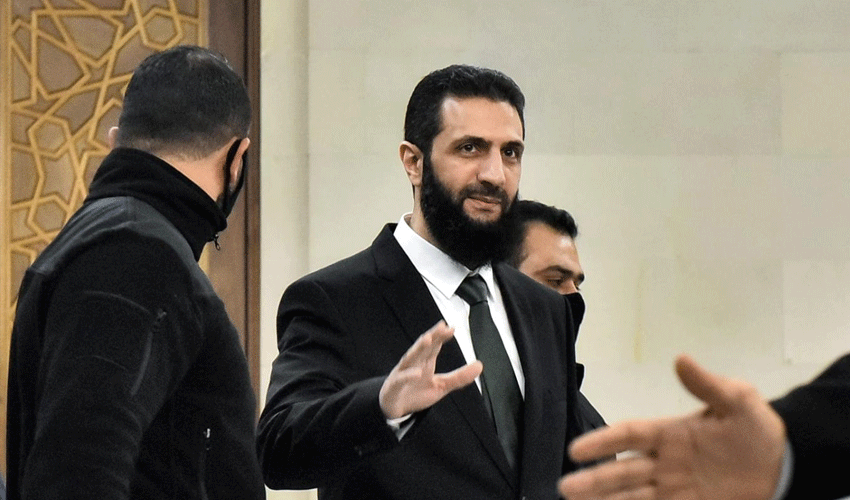

Ahmed al-Sharaa
Ahmed al-Sharaa, the de facto leader of Syria, has been appointed as the country’s president for a transitional period following the removal of President Bashar al-Assad. This significant shift in Syria’s leadership came after a rapid offensive led by al-Sharaa’s faction, Hayat Tahrir al-Sham (HTS), which successfully overthrew al-Assad last month.
With this change, al-Sharaa’s faction, HTS, has become the de facto ruling entity in Syria, establishing an interim government largely composed of officials from the administration it previously ran in the rebel-held Idlib province.
As part of the transition, Syria’s constitution has been suspended, and al-Sharaa has been authorized to form a temporary legislative council to oversee governance until a new constitution can be adopted.
This move marks a major political shift, as it dissolves the previously existing power structures that were centered around al-Assad’s regime. Hassan Abdel Ghani, a spokesperson for the new de facto government’s military operations sector, announced that the armed factions in the country would be dissolved, and all military groups would be integrated into state institutions.
This includes the dismantling of the regime’s army, security agencies, and the Baath Party, which had been in power for decades under the Assad family and its predecessors.
Al-Sharaa has pledged to guide the country through a political transition that will involve holding a national conference, forming an inclusive government, and organizing elections, a process that he estimates could take up to four years.
Additionally, he has called for the creation of a unified national army and security forces. However, analysts note that integrating the various former opposition factions, each with their own leadership and ideologies, could pose a significant challenge in the coming months.
Internationally, the situation is being closely watched, especially by the European Union, which is reportedly considering a roadmap to lift sanctions on Syria.
Senior analyst Radwan Ziadeh from the Arab Center Washington DC characterized this shift in power as a “transition to civilian hands,” suggesting that the formation of a legislative body in Syria could lead to key institutional changes in the near future.
The EU’s potential decision to ease sanctions is seen as a crucial step toward Syria’s economic recovery, and it will likely play a critical role in shaping the country’s future trajectory.
