

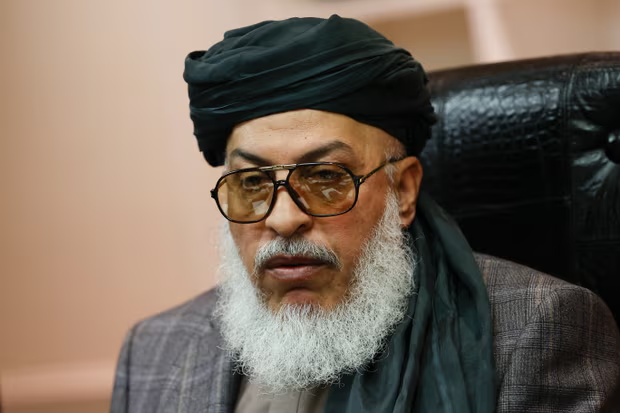

Taliban Minister
A senior Taliban minister, Mohammad Abbas Stanikzai, appears to have been forced to flee Afghanistan after expressing support for overturning the ban on girls’ education. Stanikzai, who serves as the Taliban’s deputy foreign minister, made his remarks during a graduation ceremony in Khost province near the Afghan-Pakistani border on January 20, 2025.
During his speech, Stanikzai openly criticized the Taliban government’s policy of barring girls from secondary and higher education. He strongly condemned the ban, emphasizing that there was no justification for it. “There is no excuse for this – not now and not in the future,” he stated, highlighting that the policy was depriving nearly 20 million girls of their fundamental right to education.
Drawing upon Islamic history, Stanikzai argued that both men and women had access to education during the time of Prophet Muhammad. “The doors of knowledge were open for both men and women,” he asserted.
He further pointed out the contributions of remarkable women in Islamic history, stating that their achievements would take a significant amount of time to fully elaborate on.
Following his speech and reports that he had openly criticized the Taliban leadership, Supreme Leader Hibatullah Akhundzada allegedly issued an order for his arrest and imposed a travel ban on him. This development reportedly pushed Stanikzai to flee the country, seeking refuge in the United Arab Emirates.
Stanikzai later confirmed to local media that he had traveled to Dubai, but claimed that his departure was due to health reasons rather than political pressure. The Taliban leadership has not officially commented on the situation despite multiple requests for a statement.
Since regaining power in August 2021, the Taliban has systematically restricted women’s rights, severely limiting their access to education, employment, and public life.
The group has shut down secondary schools and universities for girls, imposed strict dress codes, and banned women from many workplaces. These actions have sparked widespread international condemnation.
Last month, the International Criminal Court (ICC) chief prosecutor called for arrest warrants against the Taliban’s supreme leader and Afghanistan’s chief justice. The request was based on the argument that their persecution of women and girls in Afghanistan constitutes a crime against humanity.
Stanikzai’s sudden departure from Afghanistan underscores the deepening internal divisions within the Taliban regarding their controversial policies on women’s rights.
While some members of the leadership push for greater restrictions, others, like Stanikzai, have advocated for a more moderate approach, particularly on education. His exile signals the ongoing suppression of dissent within the Taliban ranks and the continued struggle over the future of women’s rights in Afghanistan.
