

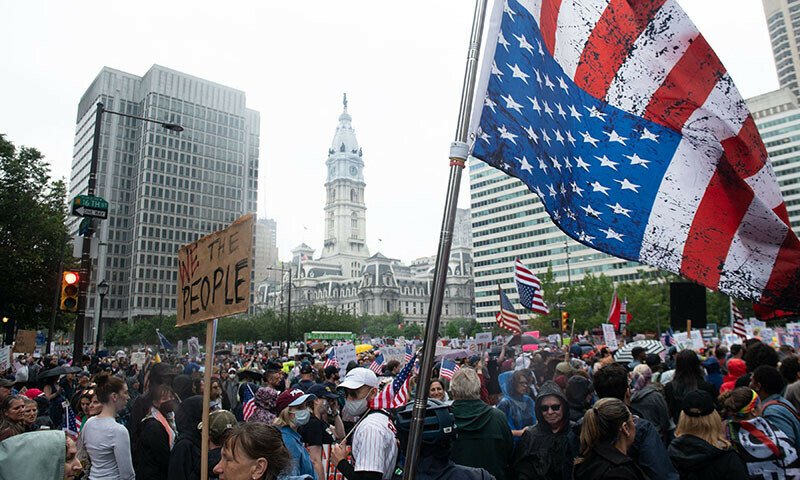

WASHINGTON: Tens of thousands of Americans took to the streets on Saturday in major cities from New York to Los Angeles, voicing strong opposition to President Donald Trump’s immigration policies and broader leadership agenda. The wave of protests coincided with a large-scale military parade in Washington, D.C., commemorating the 250th anniversary of the U.S. Army, and also marked Trump’s 79th birthday.
The demonstrations—billed under the banner “No Kings”—represented the largest show of dissent since Trump returned to office in January. Organizers said nearly 2,000 protests were planned nationwide, with the message that no leader is above the law.
However, the day of protest was overshadowed by a tragic and violent incident in Minnesota, where a Democratic state lawmaker and her husband were assassinated, and another lawmaker and his spouse wounded, in what state officials have described as a politically motivated attack.
Minnesota Governor Tim Walz confirmed the deaths of Speaker Melissa Hortman and her husband Mark early Saturday morning, calling it an “unspeakable tragedy.” In a separate attack, State Senator John Hoffman and his wife were also shot and critically injured. Both underwent emergency surgery, and Walz expressed “cautious optimism” regarding their recovery.
“This was an act of targeted political violence,” Walz said in a press briefing. “Peaceful discourse is the foundation of our democracy. We do not resolve our political disagreements at gunpoint.”
All planned protest events in Minnesota were cancelled following the shootings.
Meanwhile, tensions escalated further on the West Coast, where Trump deployed National Guard troops and U.S. Marines to Los Angeles, a move sharply criticized by California Governor Gavin Newsom, who has filed a legal challenge against the deployment.
Despite the heavy military presence and heightened security, protests in cities like Atlanta, Chicago, and Seattle remained largely peaceful, with demonstrators calling for an end to anti-immigration policies and what they view as the erosion of democratic norms.
The day’s events underscore the growing polarization across the United States as Trump’s second term unfolds under the cloud of both civil unrest and rising political violence.
A man posing as a police officer opened fire in two separate attacks targeting Minnesota lawmakers on Saturday, law enforcement authorities confirmed, triggering a large-scale manhunt. The gunman fled after exchanging fire with responding officers, prompting an intensive search effort still underway.
The violence unfolded as tens of thousands of Americans participated in protests across the country against President Donald Trump’s immigration policies and political agenda. Demonstrations under the banner “No Kings” coincided with a grand military parade in Washington, D.C., celebrating the 250th anniversary of the U.S. Army.
President Trump condemned the shootings in Minnesota, writing on Truth Social:
“I have been briefed on the terrible shooting that took place in Minnesota, which appears to be a targeted attack against state lawmakers. Such horrific violence will not be tolerated in the United States of America.”
The attacks claimed the lives of Representative Melissa Hortman and her husband, while Senator John Hoffman and his wife were critically wounded in a separate shooting. Minnesota Governor Tim Walz labeled the acts as “politically motivated assassinations,” calling the incidents “an unspeakable tragedy.”
“This was an act of targeted political violence,” Walz said. “Peaceful discourse is the foundation of our democracy. We do not settle our differences at gunpoint.”
Senate Minority Leader Chuck Schumer echoed the sentiment, saying:
“The targeted shootings of Senator Hoffman and Representative Hortman are not just horrific — they’re acts of political extremism and an assault on our democracy itself. This is where hate and violent rhetoric lead.”
Protests Met With Heavy Security
As protesters arrived in Washington for the parade, they encountered unprecedented security, including 30 kilometers of 2.4-meter-high fencing, concrete barricades, and thousands of law enforcement officers. The Federal Aviation Administration temporarily shut down Washington Reagan National Airport, while Secret Service drones monitored activity overhead.
Despite the security clampdown, rallies were held in cities nationwide, with the largest gatherings in Los Angeles, New York, Atlanta, and Chicago. In Los Angeles, a festive atmosphere prevailed ahead of the main protest, with Native American drummers and dancers performing near City Hall as demonstrators waved American and Mexican flags.
Sergio Lopez, a Navy veteran and immigrant, said he joined the demonstration because of what he described as attacks on his identity and service:
“I didn’t fight for my country to be stripped of my rights and targeted by my own government. We’re supposed to be the best country in the world. How can we be if we’re targeting the immigrants who helped build this nation?”
In Washington’s affluent northwest suburbs, small protest groups gathered at intersections, holding signs like “No Kings since 1776” and “Honor Troops, Not Trump.” At least one group, RefuseFascism.org, held a march ending near the White House, despite Trump’s warning that protesters at the parade would be met with “very big force.”
Members of the far-right Proud Boys appeared at an Atlanta rally, wearing their signature black-and-yellow colors, raising tensions at an otherwise peaceful event.
Parade Highlights Military Might, Draws Criticism
The Army’s 250th anniversary celebration includes 7,000 troops, 150 military vehicles, and historic flyovers featuring Apache and Black Hawk helicopters, Chinooks, a B-25 bomber, and a P-51 Mustang.
Among the ground equipment on display are 25 M1 Abrams tanks, 28 Stryker armored vehicles, and artillery systems such as the Paladin M109, M777, and M119 howitzers. The parade will proceed rain or shine, although forecasts predict heavy thunderstorms Saturday evening.
The cost of the celebrations is expected to range between $25 million and $45 million, according to U.S. officials—a figure critics have called excessive amid widespread budget cuts across federal agencies. Some opponents have described the parade as an authoritarian display of power, pointing to the symbolism of staging it alongside nationwide dissent.
Defenders argue the Army’s 250th anniversary warrants a historic celebration, especially at a time of heightened global tensions, as the U.S. maintains a close watch on developments following Israel’s recent missile strikes on Iran, which has vowed retaliation.
A Rare Spectacle
Military parades of this scale are rare in the United States. The last comparable event took place in 1991, following the Gulf War victory over Iraqi forces in Kuwait.
As celebrations unfolded near the Washington Monument, the stark contrast between a display of military strength and widespread civil unrest painted a picture of a deeply divided nation confronting both external threats and internal fractures.
