


Trump
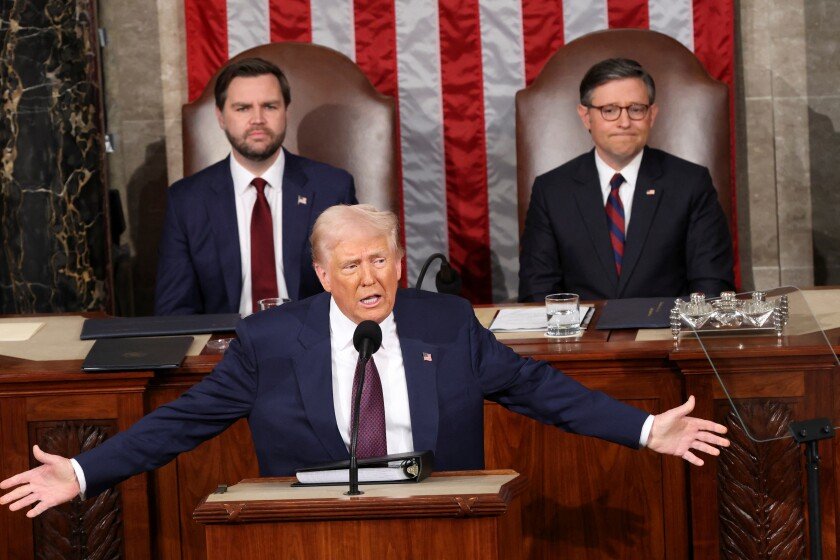
WASHINGTON: United States President Donald Trump delivered a combative address to Congress on Tuesday, celebrating what he called an aggressive and successful start to his term while facing loud protests from Democrats. The speech, lasting 100 minutes—the longest in modern US history according to The American Presidency Project—highlighted Trump’s sweeping policy moves, including imposing new tariffs, slashing the federal workforce, and pausing military aid to Ukraine.
As Trump touted his administration’s achievements, Democratic lawmakers voiced their dissent by holding up protest signs and even walking out mid-speech. The partisan divide reflected the turbulence of Trump’s first six weeks in office, which have seen major shifts in US foreign policy, the ignition of a trade war with key allies, and deep cuts to the federal government.
Trump’s speech came at a time of economic uncertainty, as markets suffered a second consecutive day of turmoil following his decision to impose heavy tariffs on Mexico, Canada, and China. While Trump defended his tariff policies as necessary to protect American industries, the move has raised concerns about inflation and economic instability, with the Nasdaq Composite falling more than 9% from its December peak.
Democratic Protests and Congressional Tensions
Trump opened his address with a bold declaration: “To my fellow citizens, America is back.” He claimed the country was on the verge of an unprecedented comeback, prompting cheers from Republicans. However, Democrats were far from impressed. Many held signs reading “No King” and “This Is NOT Normal”, while dozens walked out in protest.
The tension escalated when Democratic Representative Al Green of Texas refused to sit down, prompting House Speaker Mike Johnson to intervene. “The chair now directs the sergeant at arms to restore order. Remove this gentleman from the chamber,” Johnson declared. As Green was escorted out, some Republican lawmakers mockingly sang, “Nah, nah, nah, nah, hey, hey, goodbye.”
Trump, ever the political fighter, seemed to relish the hostility. “I look at the Democrats in front of me, and I realize there is absolutely nothing I can say to make them happy or to make them stand or smile or applaud,” he quipped after Green’s removal.
Ukraine, Russia, and Foreign Policy Shifts
The world watched closely as Trump addressed his administration’s controversial decision to pause all military aid to Ukraine. The decision came after a tense Oval Office meeting where Trump publicly berated Ukrainian President Volodymyr Zelensky.
However, Trump revealed that Zelensky had since written to him, stating Ukraine was prepared to finalize a rare-earth minerals deal that had been stalled due to their earlier disagreement. Trump also hinted at diplomatic progress with Russia, stating, “We’ve had serious discussions with Russia and have received strong signals that they are ready for peace. Wouldn’t that be beautiful?”
The decision to halt aid to Kyiv has alarmed European leaders, who fear Trump is shifting US policy too far in Moscow’s favor. Despite Trump’s remarks suggesting Ukraine bore some responsibility for the war, a recent Reuters/Ipsos poll found that 70% of Americans—across party lines—believe Russia is more to blame.
Praise for Elon Musk and Government Cuts
Trump used part of his speech to praise billionaire entrepreneur Elon Musk, who has played a key role in Trump’s newly created “Department of Government Efficiency.” According to Trump, the department has successfully downsized over 100,000 federal workers, cut billions in foreign aid, and eliminated entire agencies.
“Elon has identified hundreds of billions of dollars of fraud,” Trump claimed—though this figure far exceeds even the administration’s own estimates. Musk, who was seated in the gallery, received a standing ovation from Republicans.
More Tariffs and Economic Uncertainty
Trump reaffirmed his commitment to imposing additional reciprocal tariffs on April 2, arguing that other nations had long exploited the US through trade. “Other countries have used tariffs against us for decades, and now it’s our turn to start using them against those other countries,” he declared.
Yet, even within his own party, the policy has sparked division. While some Republicans applauded, others remained seated, reflecting concerns over the economic impact of Trump’s tariffs.
With markets already reeling from recent tariffs on Mexico, Canada, and China, investors fear further instability. The Nasdaq’s sharp decline has raised questions about Trump’s economic policies, though the president made no mention of the market downturn in his speech.
Tax Cuts and Federal Budget Concerns
Trump also urged Congress to extend his 2017 tax cuts, which are set to expire. Republicans have proposed a $4.5 trillion tax and spending plan that includes making tax cuts permanent, tightening border security, and significantly expanding deportations.
However, the proposal would also require $2 trillion in spending reductions over the next decade, potentially affecting education, healthcare, and social services. Analysts warn that Trump’s broader tax policies—including eliminating taxes on tips, overtime pay, and Social Security benefits—could cost the federal government between $5 trillion and $11.2 trillion over the next ten years.
Despite promising to balance the budget, Trump’s fiscal proposals are expected to significantly increase the national debt, which currently stands at $36 trillion. Congress will need to act later this year to raise the debt ceiling or risk a financial crisis.
Trump’s speech painted a picture of a presidency moving aggressively to reshape the country’s economy, government, and foreign policy—whether or not all Americans agree with the direction. While Republicans cheered his boldness, Democrats protested his policies, setting the stage for what promises to be a deeply polarized term.
As Trump moves forward with his ambitious agenda, the challenges of economic uncertainty, global tensions, and a divided Congress are sure to test his administration in the months ahead.
