


Tariffs
Former U.S. President Donald Trump has announced a sweeping new tariff plan as part of what he called “Liberation Day,” aiming to tackle what he described as a national emergency caused by America’s $1.2 trillion trade deficit.
The plan, revealed on Wednesday, includes a universal 10 percent tariff on all imports, with even higher duties on goods from select countries. According to the Trump administration, these tariffs will remain in place until the U.S. significantly narrows its trade imbalance.
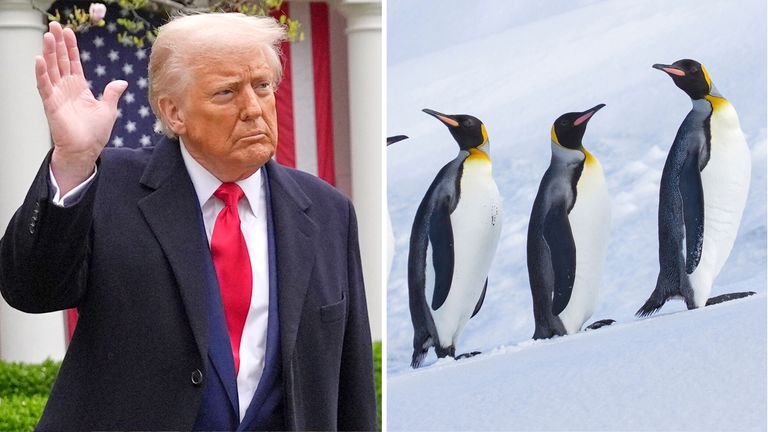
Among the more bizarre aspects of the new policy is the inclusion of the uninhabited Heard and McDonald Islands—remote, volcanic Australian territories in the southern Indian Ocean inhabited only by penguins, seals, and seabirds.
Despite their isolation and complete lack of a human population, the islands were included in the tariff list because they fall under Australian jurisdiction. A White House official cited by Axios confirmed their inclusion as part of broader tariffs against Australian external territories.
The Australian government’s website describes the islands as “one of the wildest and remotest places on Earth.” They haven’t seen a human visitor in almost a decade and are only accessible via a two-week sea voyage from Perth.
Nevertheless, the White House claims the islands impose a 10 percent “tariff to the USA,” citing currency manipulation and trade barriers. In response, the U.S. has applied a “discounted reciprocal tariff” of the same rate.
Interestingly, World Bank data showed that the U.S. imported $1.4 million worth of goods from Heard and McDonald Islands in 2022, mostly listed under “machinery and electrical” items, despite the absence of infrastructure. The islands do support a fishery, but the nature of these exports remains unclear.
Other Australian territories also found themselves on the tariff list. Norfolk Island, which has a population of just over 2,000 people, was hit with a 29 percent tariff—19 points higher than the rate imposed on mainland Australia.
In 2023, the island was reported to have exported $655,000 worth of goods to the U.S., including $413,000 in leather footwear. However, Norfolk Island administrator George Plant denied these figures, saying there are “no known exports” to the U.S. from the island.
Australian Prime Minister Anthony Albanese sharply criticized the decision, saying it shows “nowhere on Earth is safe” from U.S. trade retaliation. He pledged to defend Australian industry and consumers, calling the tariffs “unwarranted” and “unexpected.”
Trump, on the other hand, defended the move by blaming past U.S. presidents for allowing foreign nations to exploit American workers and industries. He claimed the new tariffs would generate $6 trillion over the next decade, returning wealth to the U.S. economy and benefiting taxpayers.
However, markets reacted negatively. Following Trump’s announcement—strategically timed after market hours—the Dow Jones, S&P 500, and Nasdaq all saw declines in after-hours trading.
Trump also announced that a 25 percent tariff on all foreign-made automobiles would take effect on April 3, followed by the 10 percent baseline tariff on April 5, and the reciprocal tariffs on April 9.
While Trump insists that these measures will boost American self-reliance and reduce dependency on foreign goods, critics warn that the increased costs will ultimately be passed on to American consumers and businesses, potentially disrupting the U.S. economy in the process.
