

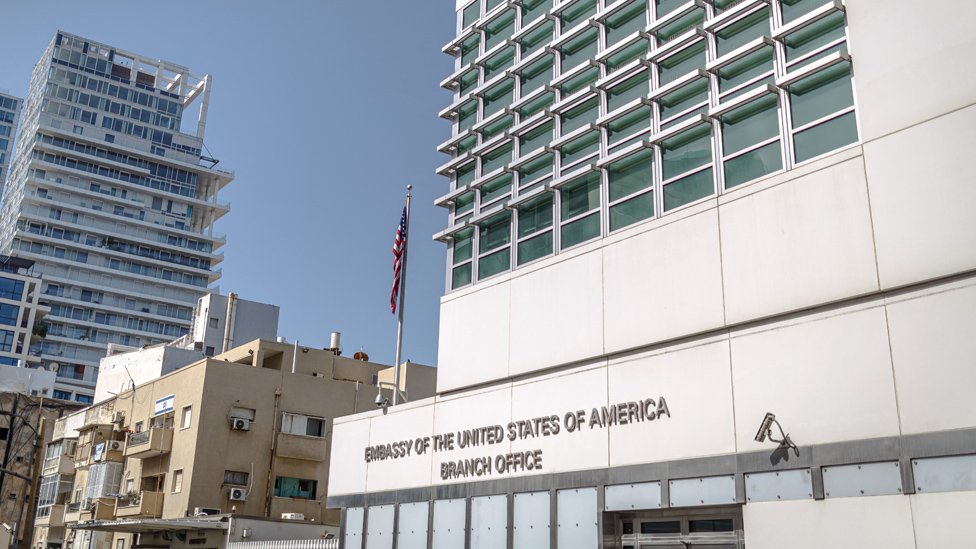

The United States on Thursday imposed new travel restrictions on its diplomatic staff and their families in Israel, citing rising regional tensions as fears grow over potential Israeli military action against Iran.
Under the updated guidance, U.S. personnel and their dependents are restricted to Tel Aviv, Jerusalem, and Beersheba, with travel between these cities and Ben Gurion Airport permitted. The advisory comes as Iran launched early military drills in response to what it described as “enemy movements,” with the Islamic Revolutionary Guard Corps (IRGC) warning of a more forceful retaliation than in previous confrontations.
These precautions are part of a broader U.S. effort to mitigate risk across the region amid deteriorating nuclear negotiations with Iran and growing speculation that Israel could strike Iranian nuclear facilities in the coming days.
Wider U.S. Precautionary Measures
The U.S. Embassy in Baghdad on Thursday advised American citizens to avoid travel to Iraq, a day after the State Department ordered the departure of nonessential staff. Similar authorization for voluntary departure was extended to U.S. personnel and families in Bahrain and Kuwait.
Despite the tension, foreign energy companies in Iraq and Bahrain report that operations remain unaffected. Bahrain’s state oil firm, Bapco Energies, confirmed it is monitoring the situation but has seen no impact on its operations. The U.S. Embassy in Bahrain also rejected reports of any operational changes, saying staffing remains normal.
The Washington Post reported that all U.S. embassies within possible Iranian missile range were instructed to convene emergency action committees and report risk mitigation steps to Washington, following concerns that an Israeli attack on Iran could prompt a large-scale response.
Iran’s Military Posturing and Warnings
On Thursday, IRGC Commander Hossein Salami warned that any Israeli aggression would trigger a “more forceful and destructive” response than past Iranian actions. Iranian media reported that the country’s military began drills earlier than scheduled to monitor enemy activity.
Iran has also threatened to strike U.S. bases in the event of an Israeli assault and has reportedly prepared hundreds of ballistic missiles for a possible counterstrike on Israel. In previous incidents, such as those in October 2023 and April 2024, many Iranian missiles and drones were intercepted by Israeli air defenses, with assistance from U.S. and regional allies. Israeli retaliatory strikes at the time caused substantial damage to Iran’s air defense systems.
Nuclear Talks at an Impasse
The developments come as nuclear negotiations between Washington and Tehran remain stalled. President Donald Trump recently expressed diminished confidence in the prospects for a deal, although talks are still set to resume on Sunday.
Tehran continues to insist on the right to low-level uranium enrichment, while the U.S. seeks tighter controls in exchange for sanctions relief. On Thursday, Iran vowed to ramp up enrichment, following a rare resolution from the International Atomic Energy Agency (IAEA) declaring the country in noncompliance with nuclear safeguards — the first such censure in two decades.
While the U.S. urges restraint, reports suggest Israel is prepared to act, creating a volatile situation that could draw in regional and global actors.
